
Learning AI takes anywhere from a weekend to five years. The difference is your goal. Using ChatGPT at work, analysing data, training models and running AI systems in production are four separate targets. Here are the real durations, taken from official course pages.
In short: allow a few hours to use generative AI tools, about 6 months at 10 hours a week for data analyst basics, about the same again for machine learning, and usually five years after secondary school to become an AI engineer. Your existing coding and maths skills make the biggest difference.
How long it takes, by goal
The durations below are those published by course providers and checked on 25 October 2026. They assume you meet the stated prerequisites.
| Your goal | Realistic time | Verified examples | Prerequisites |
|---|---|---|---|
| Use AI tools in daily work | 6 to 10 hours | Generative AI for Everyone: 6 hours. Google AI Essentials: under 10 hours | None |
| Understand AI without coding | A few hours to 6 weeks | Elements of AI: self-paced, planned over about 6 weeks | None |
| Become a data analyst | About 6 months at 10 hours a week | Google Data Analytics Certificate: 9 courses | None for the certificate |
| Do machine learning | About 6 months at 10 hours a week after Python basics | Machine Learning Crash Course: about 15 hours. Machine Learning Specialization: 2 months. Deep Learning Specialization: 3 months | Python and secondary school maths |
| Become an AI engineer | Usually 5 years after secondary school; 11 months after a scientific degree | Bachelor’s then master’s-level programme, or a Fast-Track. IBM AI Engineering: 4 months at 10 hours a week, as a complement | Programming, maths, then real experience |
The machine learning line is an AI2 calculation: about 15 hours for the Crash Course, 95 hours for the Machine Learning Specialization and 130 hours for the Deep Learning Specialization, or about 240 hours. That is close to 6 months at 10 hours a week, without Python or personal projects.
Why the answers vary so much
- Your starting point. The Deep Learning Specialization expects intermediate Python and basic linear algebra. fast.ai asks for about a year of coding and secondary school maths. Without them, add several weeks first.
- Your pace. “6 months at 10 hours a week” can become a year at 5 hours, or two months full time.
- The proof you need. Using a tool can be checked in days. A data or AI job usually needs projects, often a degree, and a first experience.
How many hours a week?
Take a goal of about 260 hours, the size of the Google Data Analytics Certificate. Here is what it means in practice (AI2 calculation):
| Time available | Typical profile | Duration for about 260 hours |
|---|---|---|
| 5 hours a week | Employed, evenings or weekends | About 52 weeks, or a year |
| 10 hours a week | The pace planned by Coursera | About 26 weeks, or 6 months |
| 35 hours a week | Full time | About 7 to 8 weeks |
The learning path, step by step
This order works for most people. Stop at the step that matches your goal.
- Understand what AI is (a few hours). Start with a no-code course such as Elements of AI, from the University of Helsinki. You will learn to separate AI, machine learning and deep learning.
- Use generative AI at work (a few hours). Generative AI for Everyone, by Andrew Ng, lasts 6 hours with no prerequisites. Google AI Essentials takes under 10 hours but is paid. Many professionals can stop here.
- Learn Python. The official Python tutorial and Kaggle Learn are free. Aim to write functions, handle lists and dictionaries, and read a file.
- Review useful maths. Secondary school maths is enough to start the Machine Learning Specialization. Add matrices, vectors, probability and statistics.
- Work with data. Use SQL to query, pandas to clean and transform, then visualisation. This is the core of a data analyst’s skill set.
- Study machine learning. Google’s Crash Course takes about 15 hours. The Inria “Machine learning in Python with scikit-learn” course announces 36 hours, in English.
- Move to deep learning and generative AI. The Deep Learning Specialization has 5 courses over 3 months at 10 hours a week. fast.ai has 9 lessons of about 90 minutes, plus practice.
- Build, deploy and get experience. A portfolio on real data counts for more than a list of certificates. At this stage, an internship teaches more than any course.
Published durations are estimates, and Coursera sometimes shows different figures on one page. Treat them as orders of magnitude and leave room for exercises.
Learn AI for free
Most of the steps above can be done without paying:
- Elements of AI (University of Helsinki and MinnaLearn): free, self-paced, no programming.
- Machine Learning Crash Course (Google): about 15 hours, free.
- Machine learning in Python with scikit-learn (Inria, FUN MOOC): 36 hours, free, with an Open Badge from 60% correct answers.
- Practical Deep Learning (fast.ai): 9 lessons of about 90 minutes, free.
Note that Google’s Data Analytics and AI Essentials certificates on Coursera are not free: Coursera’s FAQ mentions a subscription of $49 a month after a 7-day trial in the United States and Canada, and the price varies by country. Financial aid can be requested. Our guide to free AI courses with certificates shows what each one really gives you. For exams, read which AI certifications are worth it.
Can you learn AI on your own?
Yes, for everyday use and for the technical basics. To make it your job, self-study has limits: nobody corrects your work, company data is hard to find, and badges are not recognised qualifications. A good plan is to try two or three free courses to test your interest, then choose a structured route that matches your level.
Structured options at AI2
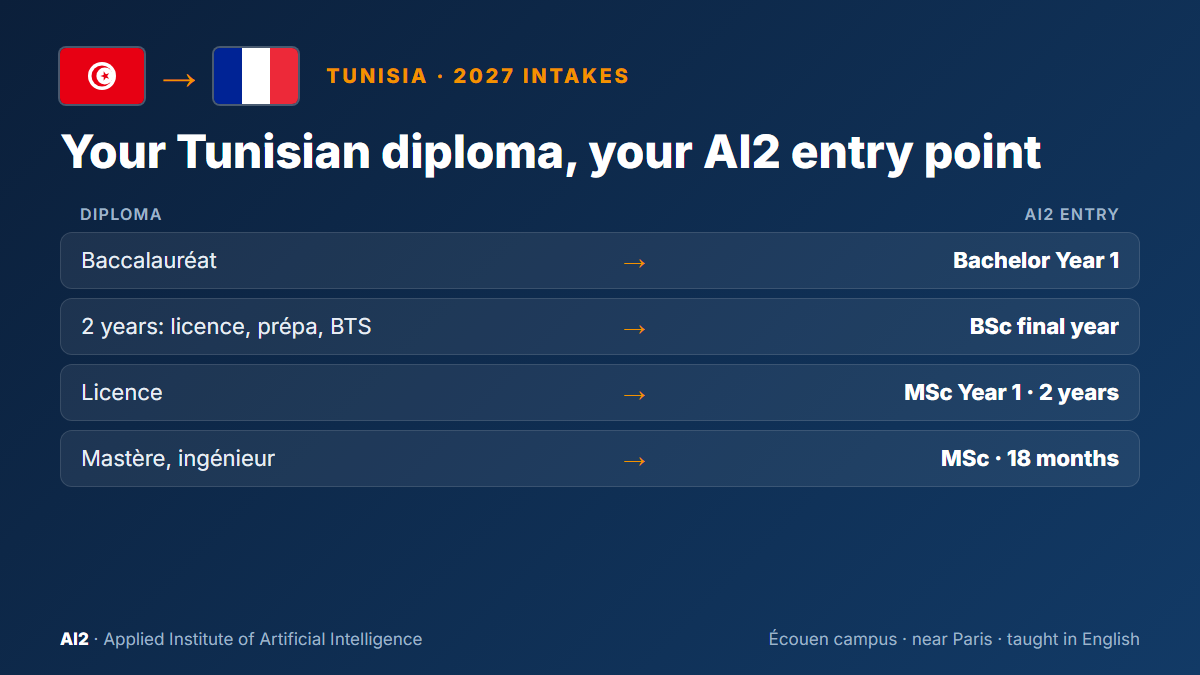
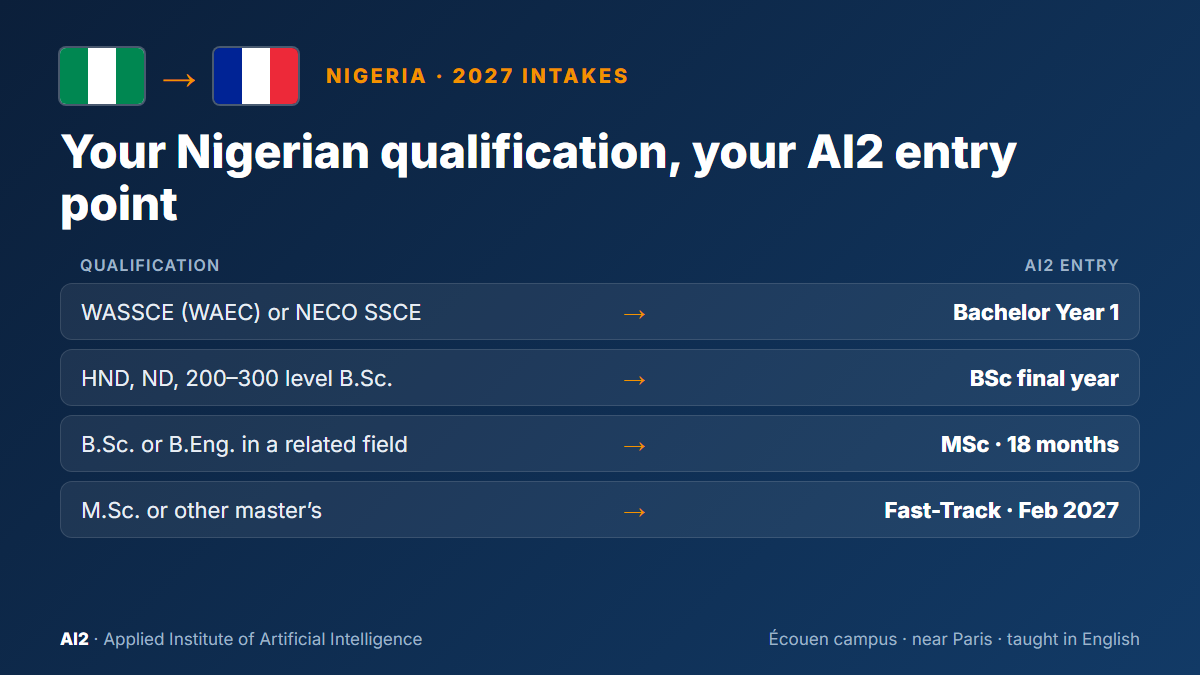
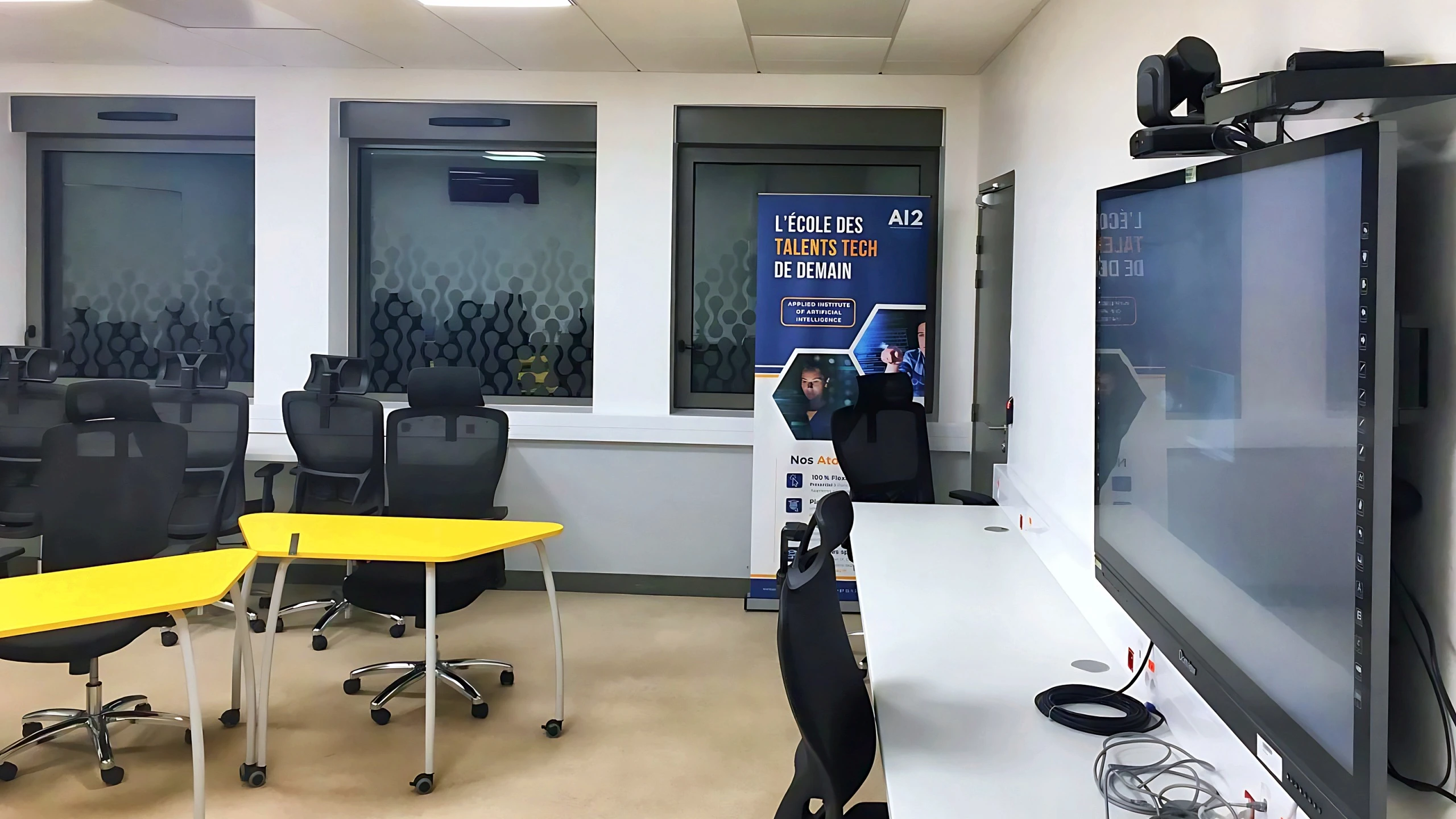
AI2 (Applied Institute of Artificial Intelligence) is a French school of applied AI and data science at Écouen, 22 minutes from Paris Gare du Nord. Its degree programmes are taught 100% in English and prepare RNCP titles at Levels 6 and 7, recognised by the French State. It also offers shorter formats if you want to test the field first: the 10-day Paris AI Summer School, in English, and online certificates of 40, 60 or 100 hours, at 4 to 6 hours a week.
| Programme | Who it is for | Tuition | Start |
|---|---|---|---|
| Bachelor in Applied AI, Years 1 and 2 | After secondary school | €9,000 a year | February, May or September 2027 |
| MSc, Year 1 | After a bachelor’s degree | €12,500, from €10,500 with scholarship | February, May or September 2027 |
| MSc, 18-month direct entry | Direct entry, subject to your academic record | €13,000 single fee, from €11,300 with scholarship | See tuition fees |
| Fast-Track Data Science, 11 months | Engineering or scientific profiles | €12,500, or €11,000 before 15 November 2026 | February 2027 |
| Paris AI Summer School, 10 days | Anyone curious about applied AI | From €1,990 | 2027 sessions from 14 March |
Frequently asked questions
How long does it take to learn AI?
It depends on your goal. Using AI tools takes a few hours (Generative AI for Everyone lasts 6 hours). Data analyst basics take about 6 months at 10 hours a week. Becoming an AI engineer usually takes about five years after secondary school.
Can I learn AI in 3 months?
You can build solid foundations in 3 months if you already code and study intensively. At 10 hours a week, 3 months equals the Deep Learning Specialization alone. That is enough to understand the field, not to be job-ready as an engineer.
Can I learn AI without coding?
Yes, to understand and use it. Elements of AI and Generative AI for Everyone need no programming, and take from about 6 hours to a few weeks. To train models yourself, you then need Python.
How many hours a week should I study?
Ten hours a week is the pace most online programmes assume. At that pace, about 260 hours take 6 months. At 5 hours, the same material takes about a year; full time, about 7 to 8 weeks.
Can I learn AI for free?
Yes. Elements of AI, Google’s Machine Learning Crash Course, the Inria scikit-learn course and fast.ai are free. Some paid Coursera certificates can also be followed with financial aid.
How long does it take to become a data analyst?
The Google Data Analytics Certificate plans 6 months at 10 hours a week, with no prerequisites. A recognised degree route takes longer, usually two years after a bachelor’s.
Is it too late to learn AI?
No. Most tools and courses are recent, and many learners come from other careers. Your earlier experience in a business, a sector or a technical job is often an advantage when you apply AI to real problems.
Sources checked on 25 October 2026: Elements of AI · Coursera: Generative AI for Everyone · Coursera: Google AI Essentials · Coursera: Google Data Analytics · Coursera: Machine Learning Specialization · Coursera: Deep Learning Specialization · Coursera: IBM AI Engineering · Google: Machine Learning Crash Course · FUN MOOC: scikit-learn · fast.ai
Tell AI2 your background and your goal: admissions reviews your file and confirms the programme that fits, with tuition and scholarship in writing.