Want a bachelor’s in France without studying in French? Where English-taught bachelor programmes actually exist, how to check that the diploma is recognised, how admission and the student visa work, and what three years really cost.
Can you study a bachelor’s in France in English?
Yes, but mostly outside the public university licence, which is usually taught in French.
France organises higher education in three levels: bachelor’s (licence), master’s and doctorate. According to Campus France, a bachelor’s requires six semesters and 180 ECTS credits, with up to 30 credits per semester. That is the same three-year format you find across most of Europe, so a French bachelor’s fits easily into a later master’s in France or elsewhere.
The difficulty is language. Campus France’s office in the United Arab Emirates states that many French universities run programmes taught fully in English, but that most of them are at master’s level, with some bachelor’s programmes in fields such as business, engineering and art. Campus France South Africa is even more direct: its catalogue of bachelor-level programmes (licence, DU, BTS) lists courses that are all taught in French.
So if you do not speak French, your realistic options are English-taught bachelor programmes at schools and private institutions, a few international tracks at public institutions, or a final-year top-up after two years of higher education at home. Campus France publishes a Taught in English catalogue for all levels; filter it for programmes that are 100% taught in English, because some courses mix English and French.
Which kinds of bachelor’s programmes can international students take?
Three families of programmes, with different rules for language, fees and admission.
| Route | Length | Language | Tuition signal | How you apply |
|---|---|---|---|---|
| Licence at a public university | 3 years, 180 ECTS | Usually French | €2,902 a year for non-EU students (2026-27) | Études en France, DAP procedure for the first year |
| Bachelor programme at a school or private institution | Usually 3 years | Often English or bilingual | Set by the institution; about €6,000 to €18,000 or more a year | Directly with the institution, or through Études en France if it is connected |
| Final-year top-up (third year only) | 1 year after two years of higher education | Depends on the programme | Set by the institution | Directly, with a review of your first two years |
Public institutions charge regulated fees. For 2026-27, Campus France gives €2,902 a year for a bachelor’s for students from outside the EU, against €178 for EU, EEA and Swiss students. Private institutions set their own fees, and Campus France puts most of them between about €6,000 and €18,000 or more a year. The gap is real, but so is the language barrier: a cheap programme you cannot follow in French is not a saving.
The top-up route deserves a closer look if you already hold an HND, a BTEC Level 5, a BTS or two years of a bachelor’s in computing. Instead of starting again in Year 1, you complete only the final year in France. We explain how it works in our guide to the top-up degree in France after an HND.
How do you check that an English-taught bachelor’s is recognised?
The word “Bachelor” on a brochure tells you nothing about the legal value of the diploma.
Campus France states that the value of a French higher education diploma is guaranteed by the State when it is a national diploma, a diploma approved by the Ministry (“diplôme visé”) or a title registered in the RNCP, the national directory of professional certifications kept by France Compétences. Any of these gives you a diploma that French employers and other institutions can check.
For an RNCP title, the check takes two minutes on the France Compétences website. Search the RNCP code given by the school and read four fields:
| Field on the RNCP sheet | What to look for | Example: RNCP37873 |
|---|---|---|
| Intitulé (title) | The exact name of the professional title | TP – Concepteur développeur d’applications |
| Niveau (level) | Level 6 corresponds to bachelor’s level (EQF 6); level 7 to master’s level | Niveau 6 |
| Certificateur (certifier) | The body that awards the title and runs the jury | Ministère du Travail, du Plein emploi et de l’Insertion |
| Etat and date d’échéance | Active status and registration valid beyond your graduation date | Active, registered until 18 December 2028 |
A level 6 title on its own is enough to prove a bachelor’s level qualification. Many students then continue to a master’s-level programme in France, which matters for the right to stay and work after graduation (see below).
How does admission work, and when should you apply?
The procedure depends on the type of institution and on the year you enter.
Students from outside the EU who apply to institutions connected to Études en France use that platform, the Campus France online platform that manages every enrolment step up to the visa request. Campus France USA describes two procedures for the 2026-27 cycle:
| Step | First year of licence (DAP) | Second or third year of licence (HDAP) |
|---|---|---|
| Applications open | 1 October 2026 | On Études en France |
| Number of programmes | Up to 3 | Up to 7 |
| Submission deadline | 15 December 2026 | 15 January 2027 |
| Decisions from institutions | By 30 April 2027 | Set by each institution |
| Your answer | By 31 May 2027 | Set by each institution |
Two points are often missed. First, Campus France notes that some French institutions are not connected to Études en France; you then apply directly on the institution’s website, on its own calendar. Second, the first-year licence route mostly leads to programmes taught in French, as Campus France South Africa points out, so it only makes sense if you can already follow lectures in French. English-taught programmes ask you to prove your English instead, through a test or English-medium schooling; check the level each institution sets.
For an English-taught bachelor’s, prepare your secondary school leaving certificate with transcripts, proof of English, a CV, a short statement of motivation and a copy of your passport. Expect an interview as well at many institutions. If you are applying straight from school, our guide to studying in France after 12th grade walks through the documents in order.
How much does a bachelor’s in France cost?
Tuition is only half of the budget. The visa sets a floor for living costs.
| Item | Amount | Source |
|---|---|---|
| Public bachelor’s, non-EU student | €2,902 a year (2026-27) | Campus France, updated 25 June 2026 |
| Public bachelor’s, EU/EEA/Swiss student | €178 a year (2026-27) | Campus France, updated 25 June 2026 |
| Private higher education institution | About €6,000 to €18,000 or more a year | Campus France, updated 25 June 2026 |
| Living costs required for the visa | At least €877.50 a month, €10,530 for twelve months | Service-Public F2231, verified 1 August 2026 |
| Visa validation on arrival | €100 tax, within three months of arrival | Service-Public F2231, verified 1 August 2026 |
For a three-year programme, multiply both lines by three: tuition plus at least €10,530 a year of living resources. Housing support has also changed. Since 1 July 2026, according to Service-Public (F12006), students from outside the EU who hold a residence permit for studies can receive the APL housing allowance only if they receive a social-criteria grant, have a professional activity, or are under an apprenticeship or professionalisation contract. Build your budget without counting on it.
Scholarships at bachelor level exist but are fewer than for master’s studies. We cover each option, from French government scholarships through embassies to institution awards, in our guide to bachelor scholarships in France for international students.
What about the student visa and working while you study?
A bachelor’s means several years in France, and the residence rules follow your study cycle.
Service-Public sets out the path for students from outside the EU. You arrive with a long-stay visa equivalent to a residence permit (VLS-TS) marked “étudiant”, valid for four months to one year, and validate it online within three months. After one year in France you can apply for a multi-year student residence card covering the years left in your cycle. Service-Public gives the example of a bachelor’s student who, after the first year, receives a two-year card. You must still be enrolled, show resources of €877.50 a month and show real and serious studies.
Part-time work
Work-study contracts
After the bachelor’s
Every step of the visa file, from the Campus France interview to the appointment at the visa centre, is covered on the AI2 visa guidance page.
How to choose: a six-point checklist
- 1Confirm the language of every moduleLectures, exams, reports and the final defence should all be in English if you do not speak French.
- 2Find the legal status of the diplomaNational degree, Ministry-approved diploma or RNCP title: get the code and check level, certifier and validity on France Compétences.
- 3Check your entry levelYear 1 after secondary school, or a final-year top-up after two years of higher education. Ask how your previous studies are mapped.
- 4Count the full costTuition for every year, plus at least €877.50 a month of resources for the visa, plus insurance, travel and visa fees.
- 5Ask about company experiencePlacements and work-study turn a bachelor’s into a first job. Ask when they start and how the search is supported.
- 6Plan the next stepCheck which master’s-level programmes you could enter afterwards, since that decides your options to stay and work in France.
AI2’s Bachelor in Applied AI: an English-taught option near Paris
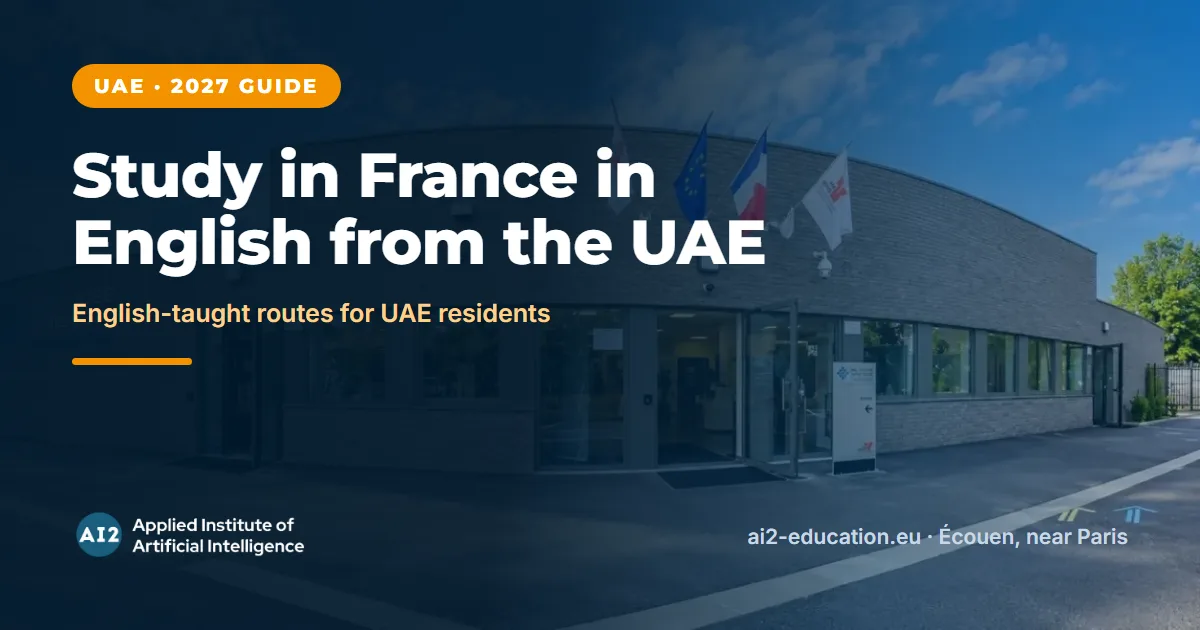
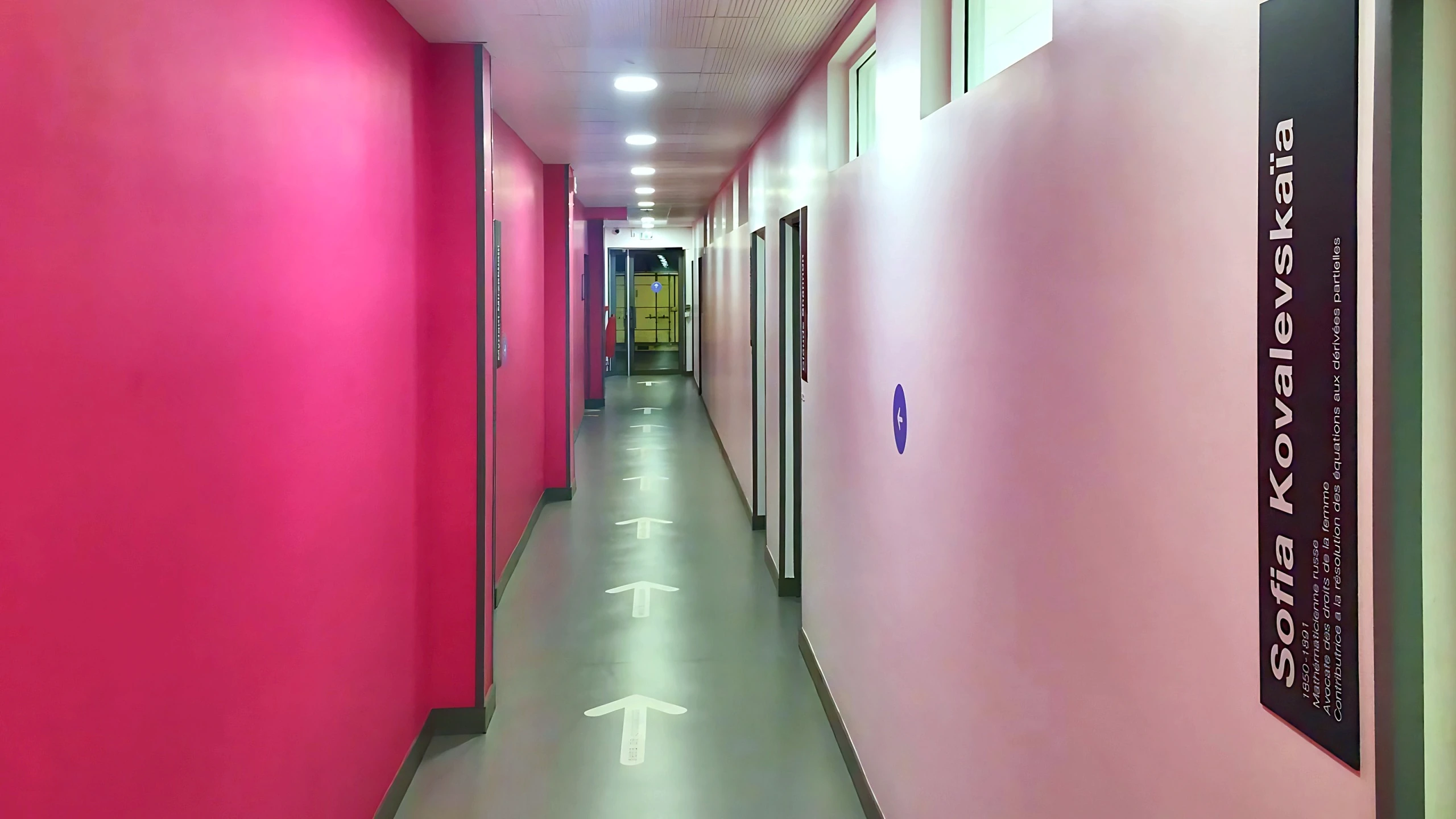
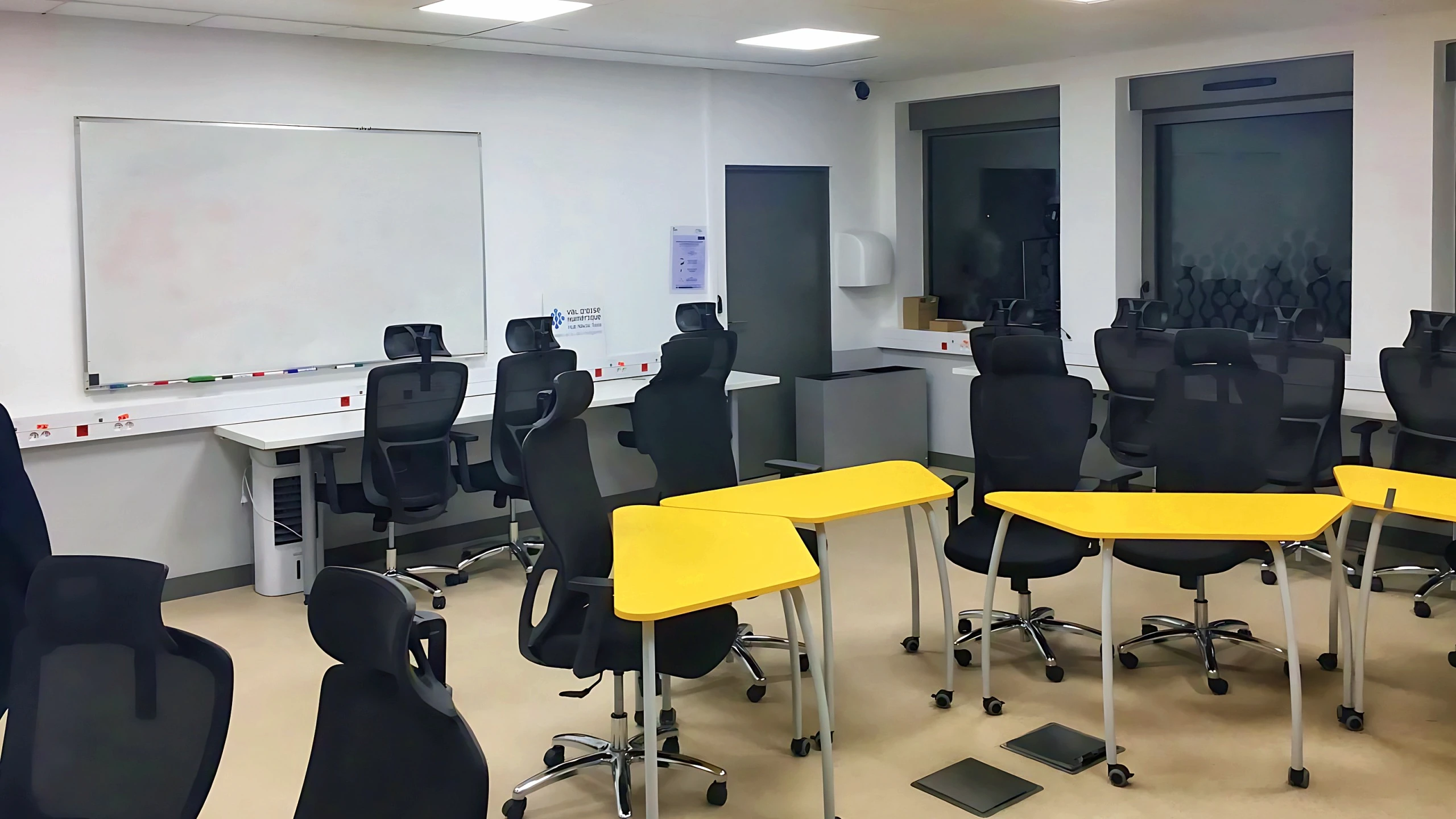
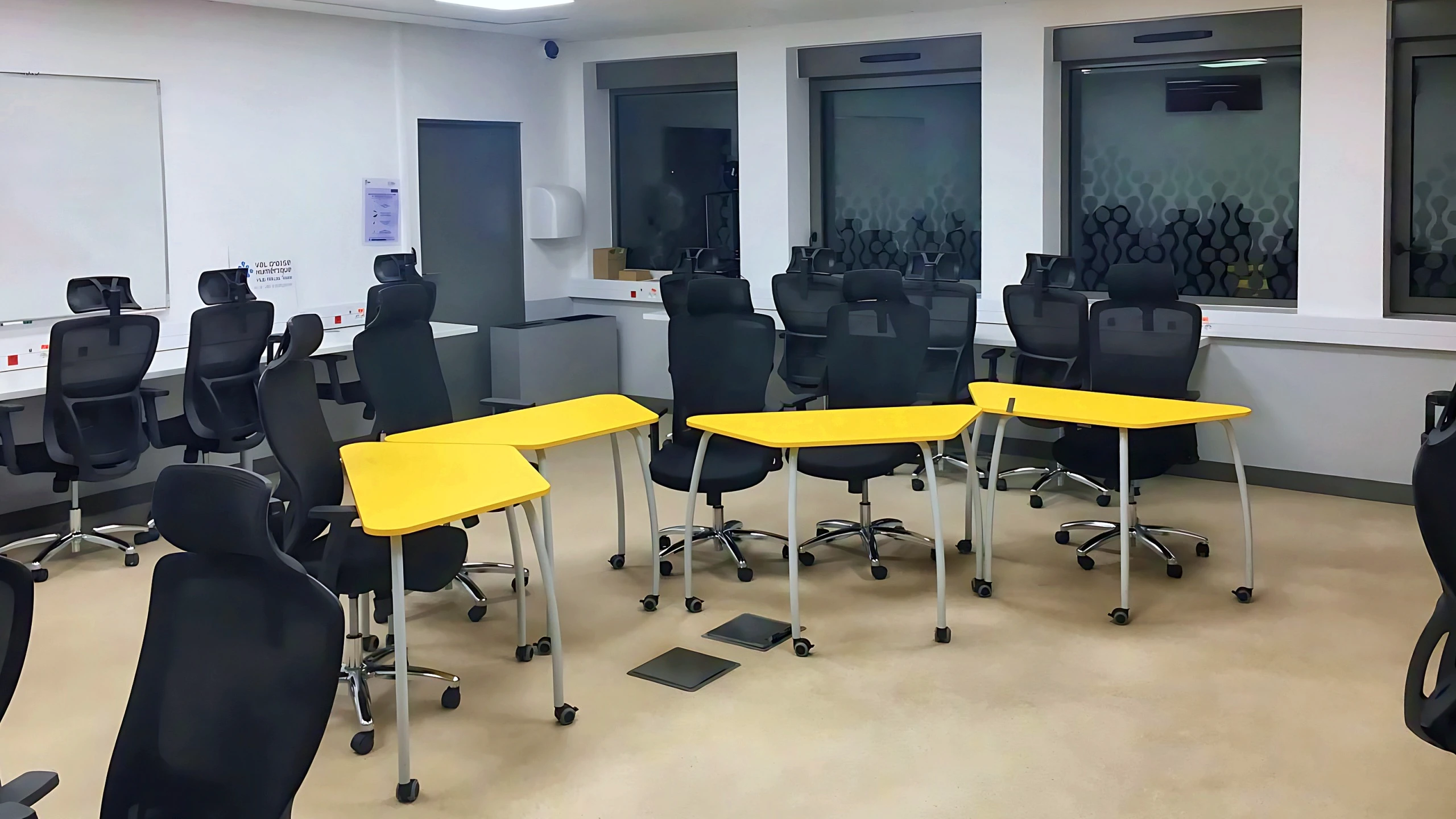
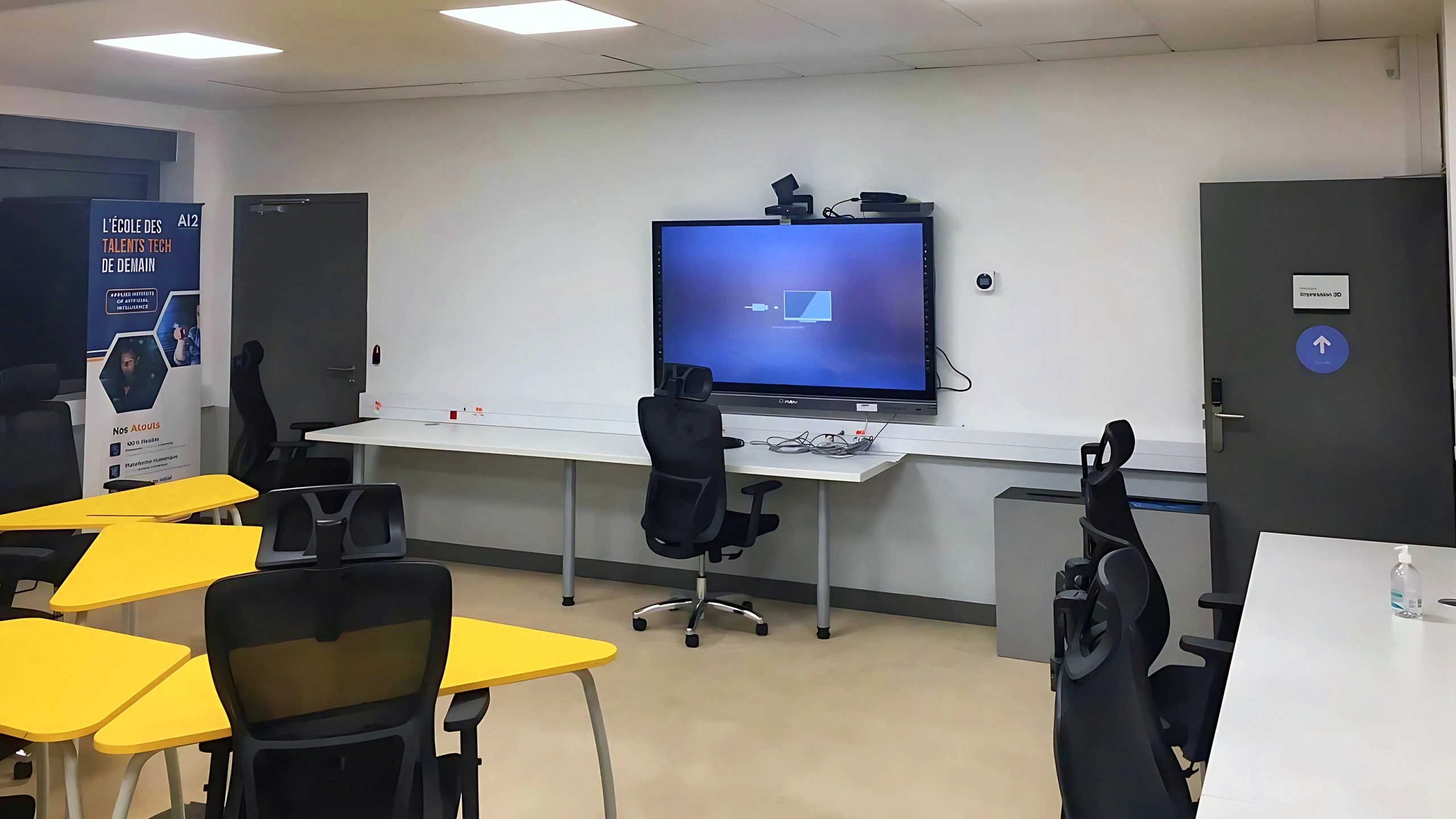
AI2, the Applied Institute of Artificial Intelligence, runs a three-year Bachelor in Applied AI taught entirely in English on its campus in Écouen, 22 minutes from Paris Gare du Nord by Transilien line H. It fits students who want to work in software, data and AI and who do not want French to be a condition of admission.
| Feature | AI2 Bachelor in Applied AI |
|---|---|
| Years 1 and 2 | Foundation years in one of two tracks: Data & AI, or Industrial IT |
| Final year | BSc AI-Powered Application Development (RNCP37873, about 500 hours plus placement) or BSc Data Analytics & Applied AI, Industry 4.0 (RNCP41370, about 450 hours plus placement) |
| Qualification | The AI2 diploma, plus preparation of a professional title recognised by the French State and registered in the RNCP at level 6 (EQF 6), certified by the Ministry of Labour |
| Entry to Year 1 | Secondary school leaving certificate with mathematics (Grade 12, A-levels or Baccalauréat); Industrial IT also accepts science |
| Entry to the final year | Two years of higher education in computing: HND, BTEC Level 5, BTS or Years 1-2 of a BSc |
| Language | 100% English; B2 level (IELTS 6.0, TOEFL iBT 72 or English-medium schooling); no French required |
| Selection | File review and an online interview |
| Tuition 2027 | Years 1 and 2: €9,000 a year; final year: €9,900; AI2 scholarships possible |
| Intakes | February, May and September 2027; priority deadline 30 November 2026 |
| Company experience | Work-study possible from Year 2, subject to a contract; company placement in the final year |
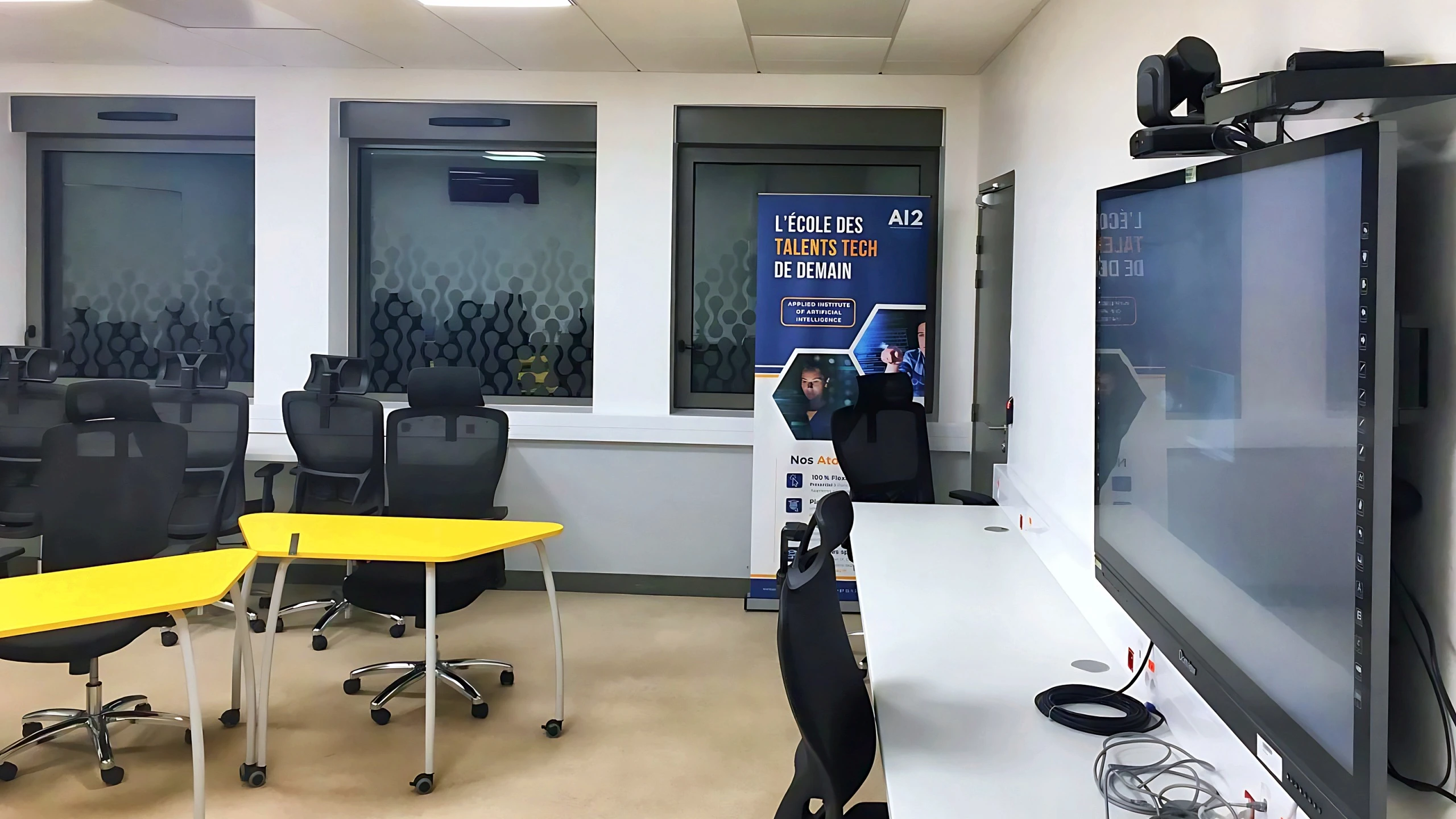
Labs run in groups of at most 12 students. After the final year, graduates can apply to AI2’s MSc programmes, subject to admission review; each MSc final year prepares an RNCP level 7 title at master’s level (EQF 7). Compare all the AI2 entry points in our guide to bachelor’s degrees in artificial intelligence in Europe taught in English, and see what is included in tuition on the AI2 tuition fees page.
📘 Related guides: Bachelor in France for Pakistani students · Bachelor in France for Sri Lankan students · Bachelor in France for UAE students.
📘 Related guide: Bachelor in France for Saudi students.
Frequently asked questions
Can I study a bachelor’s in France in English?
Yes. English-taught bachelor programmes exist, mainly at schools and private institutions, while most public university licences are taught in French. Use the Campus France Taught in English catalogue, filter for programmes 100% taught in English, and confirm that exams and the final defence are in English too.
How much does a bachelor’s in France cost for international students?
For 2026-27, Campus France gives €2,902 a year at public institutions for non-EU students and about €6,000 to €18,000 or more a year at most private institutions. For the student visa you must also show at least €877.50 a month for living costs.
How long is a bachelor’s degree in France?
Three years. Campus France states that a bachelor’s requires six semesters and 180 ECTS credits. If you already have two years of higher education, a one-year top-up into the final year can be possible.
Do I need French to get into an English-taught bachelor’s in France?
Not for a programme taught 100% in English, which usually asks for English at B2 level instead. French helps with daily life and part-time jobs, and most first-year licence programmes at public universities are taught in French.
When should I apply for a bachelor’s in France for 2027?
For the first year of a public licence starting in autumn 2027, Campus France USA gives a DAP deadline of 15 December 2026. Schools and private institutions set their own calendars; AI2 has intakes in February, May and September 2027 with a priority deadline of 30 November 2026.
Can I work while studying for a bachelor’s in France?
Yes. With a student residence permit you can work up to 964 hours a year without a separate authorisation, according to Service-Public. Apprenticeship contracts are not limited to 964 hours but generally require more than one year in France first.
Is an English-taught bachelor’s from a private institution recognised in France?
It is recognised when it is a national diploma, a Ministry-approved diploma or a title registered in the RNCP. For an RNCP title, check the code on France Compétences: level 6 corresponds to bachelor’s level (EQF 6).
Sources consulted on 29 October 2026: Campus France: French degrees, LMD system and equivalences · Campus France: tuition fees 2026-27 (updated 25 June 2026) · Campus France UAE: programmes taught in English · Campus France South Africa: find your programme · Campus France USA: applying to a French institution, DAP and HDAP calendar 2026-27 · Service-Public: student visa and residence permit, F2231 (verified 1 August 2026) · Service-Public: work for foreign students, F2713 (verified 7 October 2025) · Service-Public: job-search or business-creation permit, F17319 (verified 1 June 2026) · Service-Public: APL housing allowance, F12006 (verified 1 July 2026) · France Compétences: RNCP37873 · France Compétences: RNCP41370 · AI2: Bachelor in Applied AI · AI2: BSc AI-Powered Application Development · AI2: BSc Data Analytics and Applied AI · AI2: tuition fees 2027
AI2’s admissions team reviews your school or college record, holds an online interview and tells you whether you enter Year 1 or the final year. Intakes in February, May and September 2027; priority deadline 30 November 2026.