Canada offers a longer work permit after a master’s. France has no study permit cap and a lower bar on funds. For students from India and Africa, four things decide: getting the permit, the money to show, work hours and post-study stay. Each is compared below from IRCC, Campus France and Service-Public pages.
France vs Canada at a glance
Each line is sourced from an official French or Canadian page listed at the end of this article.
| Criterion | France | Canada |
|---|---|---|
| Tuition | €3,950 a year for a master’s at public institutions in 2026 to 2027; about €6,000 to €18,000 or more at private ones | Set by each institution; not covered by the living-funds amount |
| Entry gate | Études en France file with Campus France in 75 countries, then a long-stay student visa (VLS-TS) | Letter of acceptance plus, in most cases, a provincial or territorial attestation letter (PAL/TAL); master’s students at public institutions are exempt since 1 January 2026 |
| Living funds to prove | At least €877.50 a month, about €10,530 a year | CAN$23,448 a year for one person, from 1 September 2026, excluding tuition and travel |
| Government fees | Visa fee set by country, plus a €100 tax to validate the visa in France | CAN$150 study permit plus CAN$85 biometrics |
| Work during studies | 964 hours a year, no work authorisation | 24 hours a week off campus during sessions, unlimited in scheduled breaks |
| After a master’s | One-year job-search or business permit, not renewable; APS for some nationalities | PGWP of up to 3 years, even for a master’s under 2 years; CLB 7 or NCLC 7 required |
| Spouse | Each family member applies for their own visa | Open work permit if your master’s lasts 16 months or more |
| Processing time | Depends on the consulate and the Campus France calendar in your country | Varies by country; IRCC publishes estimates updated weekly |
Getting in: the Canadian cap versus the Campus France file
Canada: a national cap, with an exemption for public master’s programmes
Canada limits the number of study permits it issues. In its notice of 25 November 2025 on the 2026 allocations, IRCC said it expected to issue up to 408,000 study permits in 2026, including 155,000 to newly arriving students, and set aside 49,000 for master’s and doctoral students enrolling at public designated learning institutions (DLIs). Up to 180,000 permits were expected for applicants who need an attestation letter.
The attestation letter, called a PAL or TAL, is issued by the province or territory through your school. IRCC lists it as needed in most cases, usually after you accept your offer and pay all or part of your tuition. Since 1 January 2026, students admitted to a degree-granting master’s or doctoral programme at a public institution do not need one. The exemption is worded for public institutions only, so a master’s at a private DLI still needs the letter, and students heading to Quebec must meet that province’s own requirements, including a Quebec Acceptance Certificate (CAQ).
What about 2027? On 27 October 2026 we found no published allocation notice for the 2027 cap year. IRCC’s 2026 to 2027 Departmental Plan sets a target of 150,000 new international student arrivals for 2027, slightly below the 155,000 planned for 2026. Check the IRCC notices page before you apply.
France: one online file, then the visa
France has no national study permit cap of the Canadian kind. Instead, residents of 75 countries and territories, including India, Nigeria, Kenya, Ghana, Senegal, Cameroon, Ivory Coast, Morocco and Ethiopia, go through Études en France, the online platform run by Campus France that handles the application up to the visa request. Campus France updated that page on 28 September 2026; the fee for its assistance is set by each local office. Once Campus France has processed your file, you apply for the long-stay student visa (VLS-TS) at the consulate.
Proof of funds: how much money you must show
IRCC sets a yearly amount that excludes tuition and transport. For applications made on or after 1 September 2026, outside Quebec, the figures are:
| People in your family unit, including you | Amount per year (Canada, outside Quebec) |
|---|---|
| 1 (you alone) | CAN$23,448 |
| 2 | CAN$29,192 |
| 3 | CAN$35,888 |
| 4 | CAN$43,572 |
From 1 January 2025 to 31 August 2026 the single-person amount was CAN$22,895; IRCC updates the figures every year, so check again when you apply.
France counts by month: Service-Public sets €877.50 a month, about €10,530 over twelve months. A parent can sponsor you with an identity document and proof of regular transfers, or a signed commitment to pay. For many families, the gap between the two thresholds decides.
Fees and processing times
CAN$150 plus CAN$85
Processing: check the tool
Visa, then €100 in France
Plan backwards from your start date in both countries. For France, the Campus France step and the consulate appointment come first; our guide to France student visa processing times breaks the timeline down by stage.
Working while you study
24 hours a week off campus
964 hours a year
Canada’s rule is weekly with free holidays, and applies all year if your programme has no scheduled breaks. France’s is a yearly total: 964 hours averages about 18.5 hours a week over 52 weeks, spread as you choose.
France also allows apprenticeship contracts, where a company employs you and funds your training; Service-Public waives the usual one-year residence condition for students in a programme leading to a master’s.
After graduation: PGWP versus the French permits
Canada: the post-graduation work permit
- The PGWP is open to graduates of a PGWP-eligible DLI whose programme lasted at least eight months. A course at a school that is not PGWP-eligible does not qualify.
- There is no field-of-study requirement for graduates of a bachelor’s, master’s or doctoral degree. Field-of-study lists apply to college and other programmes that are not bachelor’s, master’s or doctoral degrees.
- Since 15 February 2024, master’s graduates can apply for a three-year PGWP even if the programme lasted less than two years.
- University graduates must show CLB 7 in English or NCLC 7 in French in all four skills, for applications made since 1 November 2024.
- You must apply within 180 days of confirmation that you completed your programme.
- The permit cannot run beyond your passport’s validity, and you cannot get a second PGWP if you already had one after an earlier programme.
France: job search, then a work permit
Service-Public describes a one-year job-search or business-creation permit, not renewable, for graduates of a master’s or an equivalent diploma obtained in France. While it is valid, a job linked to your studies and paid above €2,800.53 gross a month needs no work authorisation, and the 964-hour cap no longer applies. If you leave France after graduating, you can still apply within four years of obtaining the diploma. Algerian nationals follow separate rules.
Once you have a job, you switch to a work permit. A job related to your studies at €2,800.53 gross a month or more opens a salaried permit without a job-market test; a salary of at least €39,582 gross a year opens the multi-year talent permit for qualified employees, valid for up to four years. Nationals of countries that have signed a migration agreement with France can request an APS for a first job, and Campus France India describes a 24-month post-study stay for Indian graduates, in two periods of 12 months.
On paper, Canada’s three years beat France’s one; in practice, compare the conditions on each side. Our guide to working in France after graduation covers each French permit.
Coming with a spouse or children
Canada is more open to families. Since 21 January 2025, the spouse or common-law partner of a student in a master’s programme of 16 months or longer can apply for an open work permit; shorter master’s programmes do not qualify. IRCC’s graduate-student page adds that family members can apply for visitor visas, work permits or study permits, depending on their situation.
In France, no dependant status is attached to the student visa. Campus France advises that each dependant needs a visa of their own, with the type determined through France-Visas. If you plan to move with a partner who must work, this point favours Canada, provided your programme reaches 16 months.
Tuition and the real cost of the degree
Canadian institutions set their own international tuition, and IRCC’s funds requirement does not include it, so your bank evidence must cover both. In France, Campus France gives €3,950 a year for a master’s at public institutions in 2026 to 2027, with possible exemptions decided by each institution, and about €6,000 to €18,000 or more a year at private ones. Our explainer is studying in France free? sets out who pays what.
So, France or Canada for your master’s?
| If this sounds like you | Lean towards | Why |
|---|---|---|
| You want the longest post-study work permit and can show CAN$23,448 a year plus tuition | Canada | A master’s can lead to a three-year PGWP |
| Your spouse must work while you study | Canada | Open work permit for master’s programmes of 16 months or more |
| Your family budget fits €877.50 a month better than the Canadian amount | France | The French threshold is lower and counted monthly |
| You want to avoid a national study permit cap | France | No national cap like Canada’s; the Campus France file is the key step |
| You want a company placement or a salaried work-study contract | France | Apprenticeship contracts are open to master’s students |
| You are a French speaker from West or Central Africa | France | You can choose between French-taught and English-taught programmes |
| You want to start in February or May rather than wait for autumn | France | Some institutions, AI2 included, run February and May 2027 intakes |
Where AI2 fits if France is your choice
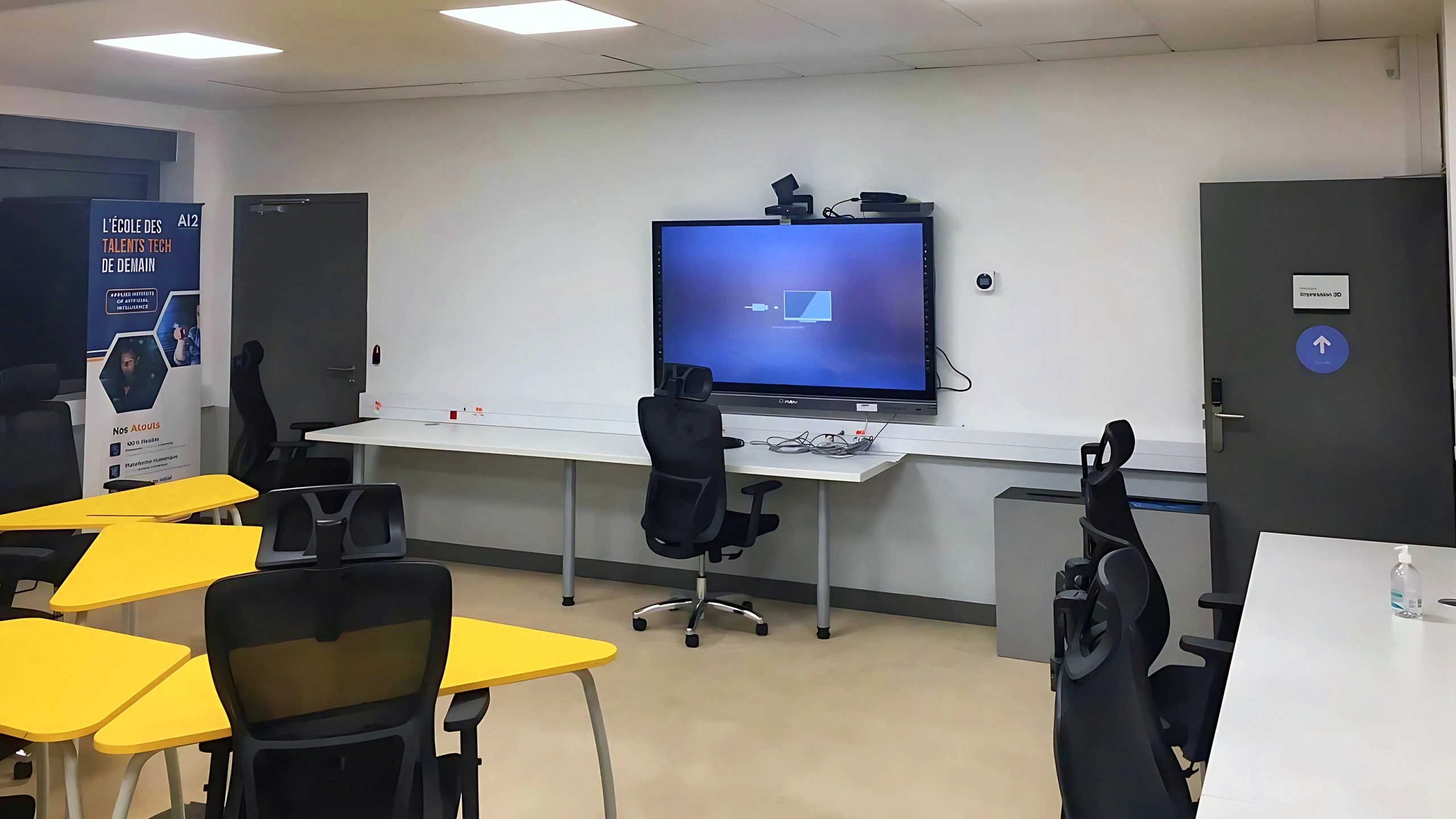
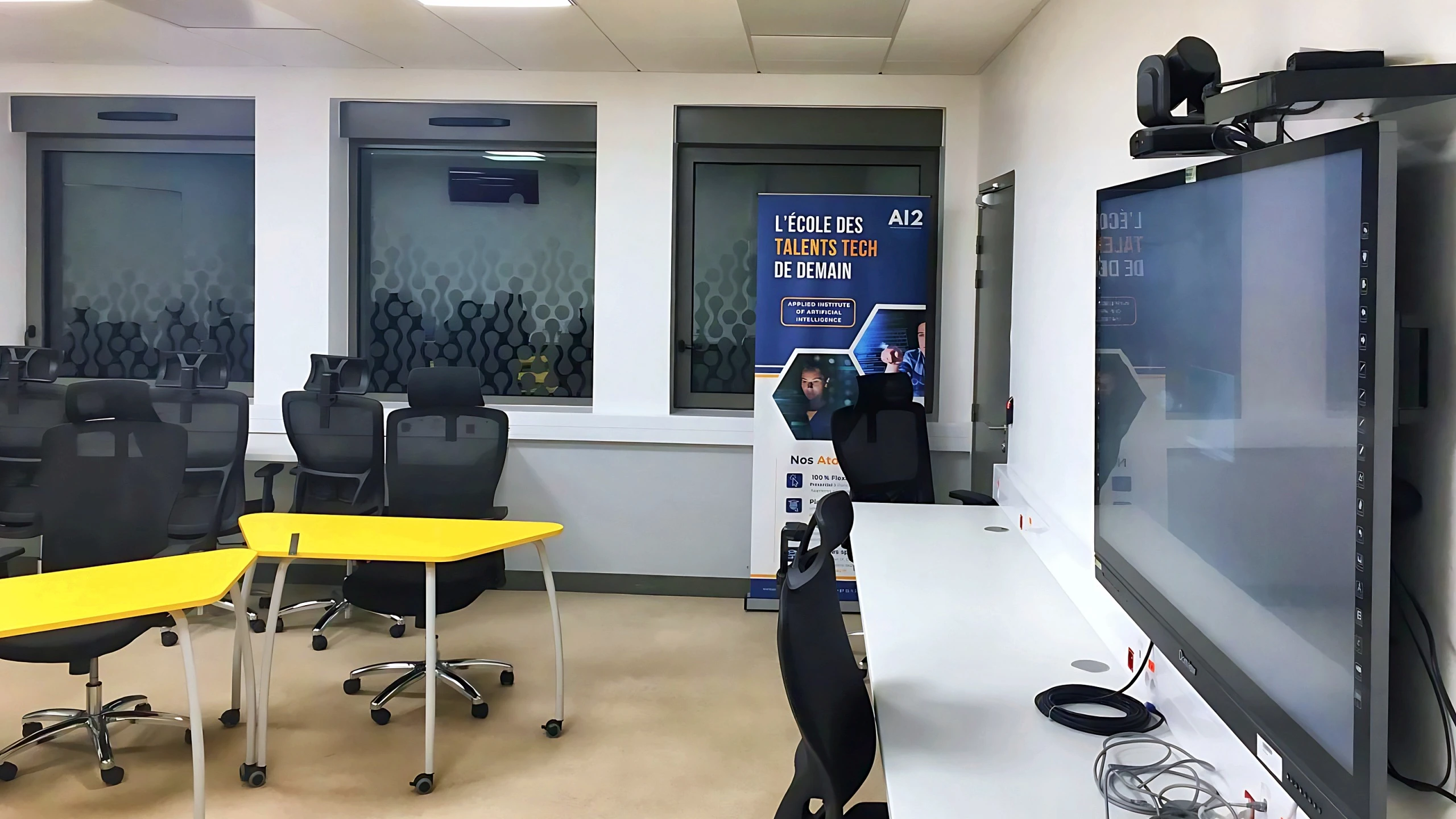
AI2, the Applied Institute of Artificial Intelligence, is a private institution on the Hub Nikola Tesla campus in Écouen, 22 minutes from Paris Gare du Nord by Transilien line H. Teaching, exams and jury defences are all in English; the requirement is B2 (IELTS 6.0, TOEFL iBT 72 or equivalent, and a medium-of-instruction certificate may support a waiver), French is not required and optional French classes are offered. Admission is a file review plus an online interview, without GRE or GMAT. For the wider picture of English-taught study in the region, see AI courses in Paris.
Three MSc formats match different degrees, from three-year bachelor’s to four-year B.Tech:
- MSc, 2 years after a three-year bachelor’s in computing, mathematics, engineering or science: Year 1 is €12,500, from €10,500 after the conditional AI2 scholarship.
- Direct entry, 18 months after a related four- or five-year degree: 12 months on campus and a six-month internship, €13,000, from €11,300 after scholarship (IoT from €11,800).
- Fast-Track, 11 months, February 2027 only, for an accredited four-year B.Tech or BE or a master’s: five months on campus, then six months in a company in France, €11,000 for applications before 15 November 2026, then €12,500.
Intakes are planned in February, May and September 2027, with a priority deadline of 30 November 2026 for February. Each final year awards the AI2 diploma and prepares a professional certification recognised by the French State and registered at RNCP level 7, the master’s level (EQF 7): RNCP39978 « Architecte des systèmes d’information dans les processus industriels » for the Data Science and Cybersecurity tracks, and RNCP40554 « Architecte Internet des objets (IoT) » for IoT. AI2’s programme pages state that RNCP level 7 titles appear on the official list of diplomas at least equivalent to a master’s for residence purposes; the préfecture decides each permit.
Work-study is possible from MSc Year 2, when an employer’s training fund pays tuition and you earn a salary, subject to finding an employer. See a master’s in France after a B.Tech for entry-year rules, AI2 tuition fees 2027 for every format, and the MSc Applied AI and Data Science for the full curriculum.
Frequently asked questions
Is France or Canada better for a master’s?
Canada suits students who can show CAN$23,448 a year plus tuition and want a post-graduation work permit of up to three years. France suits students who want a lower funds threshold of €877.50 a month, no study permit cap, 964 work hours a year and a one-year job-search permit after a master’s.
Do master’s students need a PAL for Canada?
Not if they are admitted to a degree-granting master’s or doctoral programme at a public institution: that exemption applies since 1 January 2026. Master’s students at private institutions still need a PAL or TAL in most cases, and Quebec applies its own rules.
How much money do I need to show for a Canadian study permit?
For applications made from 1 September 2026, outside Quebec, CAN$23,448 a year for one person, excluding tuition and transport, and more for each family member. France asks for at least €877.50 a month.
How many hours can international students work in Canada and France?
Canada allows up to 24 hours a week off campus during sessions and unlimited hours during scheduled breaks. France allows 964 hours a year without a work authorisation.
Is there a field of study rule for the PGWP after a master’s?
No. IRCC states that there are no field of study requirements for graduates of a bachelor’s, master’s or doctoral degree. You still need a PGWP-eligible institution, a programme of at least eight months and CLB 7 or NCLC 7 in all four skills.
How long can I stay after graduating?
In Canada, a master’s can lead to a PGWP of up to three years, even if the programme lasted less than two years. In France, graduates of a master’s or equivalent get a one-year, non-renewable job-search permit, and nationals of countries with a migration agreement may obtain an APS.
Can my spouse work in Canada or France while I study?
In Canada, yes, through an open work permit if your master’s lasts 16 months or more. In France, no dependant status is attached to the student visa: Campus France advises a separate visa for each dependant.
Also comparing Ireland? Read France vs Ireland for a master’s.
Sources consulted on 27 October 2026: IRCC: proof of financial support · IRCC: documents for a study permit · IRCC: attestation letter · IRCC: study permit for graduate students · IRCC: 2026 cap allocations · IRCC: 2026 to 2027 Departmental Plan · IRCC: work off campus · IRCC: PGWP eligibility · IRCC: PGWP length · IRCC: spouse work permit · IRCC: fee list · IRCC: processing times · Campus France: tuition fees · Campus France: Études en France · Campus France USA: students with families · Campus France India: post-study stay · Service-Public: student visa and resources · Service-Public: long-stay visa · Service-Public: work for foreign students · Service-Public: job-search permit · Service-Public: talent permit
Apply to AI2’s English-taught MSc near Paris: admissions reviews your file, holds an online interview and confirms your format, tuition and scholarship in writing.