The UK is quicker. France usually means a longer course, a company placement and no health surcharge. A taught master’s in the UK often fits into about twelve months, while a standard French master’s runs over two years. Here are the rules on visa costs, funds, work, families and post-study permits, from gov.uk, UKCISA, Service-Public and Campus France.
France vs UK at a glance
Every line comes from an official page listed at the end of this article, read on 27 October 2026.
| Criterion | France | United Kingdom |
|---|---|---|
| Usual length of a master’s | Two years: four semesters and 120 ECTS after a bachelor’s; some institutions run shorter formats | Often around one year; gov.uk itself uses a one-year master’s as its example |
| Tuition for non-EU students | €3,950 a year for a master’s at public institutions in 2026 to 2027; about €6,000 to €18,000 or more at private ones | Set by each university and written on your CAS; you must show you can pay the first year |
| Visa application fee | Varies by country (France-Visas tariff), plus a €100 tax when you validate the visa in France | £558 for a Student visa applied for outside the UK |
| Health charge paid with the visa | No immigration health surcharge | £776 per year of visa for students |
| Living funds to prove | At least €877.50 a month, about €10,530 for twelve months | £1,529 a month in London or £1,171 elsewhere, for up to 9 months |
| Work during studies | 964 hours a year without a work authorisation | Up to 20 hours a week in term time at degree level, full time in vacations |
| After graduation | One-year job-search or business permit for a master’s or equivalent; APS for some nationalities | Graduate visa: 2 years if you apply by 31 December 2026, 18 months from 1 January 2027 |
| Partner and children | The student visa covers the student; each dependant applies for their own visa | Not possible on a taught master’s that started on or after 1 January 2024, unless government-sponsored |
| English level | Set by each institution for English-taught programmes | B2 for degree-level study, by an approved test or the university’s own assessment |
One year or two: what course length really changes
Time is the first thing most students notice. UK taught master’s programmes are commonly built to finish within about twelve months, and the gov.uk Graduate visa guide uses a one-year master’s as its standard example. In France, Campus France describes the national structure as four semesters and 120 ECTS credits on top of a 180-credit bachelor’s, which makes a full master’s a two-year commitment.
Shorter is not automatically better. One year means one year of rent and an earlier salary, but also a dense calendar where dissertation, exams and job applications overlap, with little room for a long internship. A two-year French master’s usually leaves space for a placement in a company, so you gain local experience before applying for a post-study permit.
Length also matters for the UK Graduate visa: UKCISA explains that for a course of 12 months or less you must have held Student permission for the whole course, with all study in the UK. In France, the post-study permit depends on the level of the diploma, a master’s or equivalent, not on months spent in the country. Holders of a four-year degree can also find shorter French formats of 11 to 18 months; one example closes this guide.
Tuition: comparing a year with a degree
The UK has no national fee for international students: each university sets its own, shown on your Confirmation of Acceptance for Studies (CAS), and the visa requires proof that you can pay one academic year, up to nine months.
France publishes a national rate for public institutions under the higher education ministry. Campus France gives €3,950 a year for a master’s in 2026 to 2027 for students from outside the EU, and notes that a decree of 19 May 2026 changed the rules on fee waivers that institutions may grant. Private institutions, Campus France adds, generally charge from about €6,000 to €18,000 or more a year.
Compare the cost of the whole degree, not the annual fee: usually one year in the UK, two in France at public rates, or a single-fee shorter format at some private institutions. Then add visa, health and rent.
Visa and health costs before you arrive
Student visa: £558
Health surcharge: £1,164 for a typical one-year course
Études en France, visa, then €100
For one person on a one-year UK master’s, visa and surcharge add up to £1,722 before any priority service. The French student visa (VLS-TS) lasts four months to one year; after a year in France you can ask for a multi-year student card of two to four years.
Proof of funds: two different logics
The UK counts a fixed number of months. Since 11 November 2025, according to UKCISA, applicants must show £1,529 a month for courses in London or £1,171 a month elsewhere, for up to nine months: £13,761 in London or £10,539 outside it, on top of the first year of fees. The money must sit in the account for at least 28 consecutive days, and the end of that period must fall within 31 days of your application.
Nationals of countries on the UK’s “differential evidence” list may not need to submit this proof up front, although UKVI can still ask for it. The list includes France, Germany, Malaysia and the United States; India, Nigeria and Pakistan are not on it, so applicants from those countries should expect to show bank evidence.
France uses a monthly threshold for the whole stay. Service-Public sets it at €877.50 a month, roughly €10,530 a year, proven by a bank statement or by a sponsor’s identity document and evidence of regular transfers. In both countries this is a visa minimum, not a living budget.
Working while you study
20 hours a week in term time
964 hours a year
The UK caps each week of term and frees the holidays. France sets an annual envelope: 964 hours averages about 18.5 hours a week over 52 weeks, spread as you choose, and exceeding it can cost you your residence permit. Neither status allows self-employment: UKCISA lists it among the work UK students must not do, and Service-Public says the French student card does not allow micro-entrepreneur status.
France adds the apprenticeship contract, where a company employs you and funds your training. Service-Public normally requires one year of residence first, but not for students in a programme leading to a master’s. See working while studying in France for wages and contracts.
After graduation: 18 months in the UK, one year and further routes in France
Graduate visa: 18 months from 2027
Cost and conditions
Job-search permit: one year
Talent permit and agreements
If you start a one-year UK master’s in 2026 or 2027, you will apply in 2027 or later, so plan with 18 months, during which most jobs and self-employment are allowed. The French year is shorter, but a qualifying job moves you to a salaried permit without a job-market test, and graduates who left France can apply within four years of their diploma. See working in France after graduation.
Bringing a partner or children
This is where many families are surprised. Under gov.uk rules, a student on a postgraduate course that started on or after 1 January 2024 can bring dependants only if it is a PhD, another doctorate or a research-based higher degree, or if the student is government-sponsored on a course longer than six months. A taught one-year master’s therefore does not allow a partner or children to join as dependants.
France has no dependant category attached to the student visa either: Campus France says each dependant needs a visa of their own, chosen through France-Visas. UKCISA adds that, in the UK, usually only existing Student dependants can become Graduate dependants.
Language: English in both, French as a career bonus
A UK Student visa at degree level requires English at B2 (CEFR), shown by an approved test or your university’s own assessment; a degree taught in English can count if Ecctis confirms it. In France, each English-taught programme sets its own requirement. French is not needed to study in English, though it helps in daily life and the job search. See studying in France without IELTS.
So, should you study in France or the UK?
| If this sounds like you | Lean towards | Why |
|---|---|---|
| You want the shortest possible course and can fund one intensive year | UK | A one-year master’s is common, and you start earning sooner |
| You want 18 months to work in any job after graduating | UK | The Graduate visa allows most jobs and self-employment |
| You want a placement in a company as part of the degree | France | Two-year formats leave room for a long internship or work-study |
| You want to avoid a health surcharge on top of the visa | France | No immigration health surcharge; a €100 validation tax after arrival |
| You want a salaried work-study contract that covers tuition | France | Apprenticeship contracts are open to master’s students without the one-year residence condition |
| You missed the autumn start | France | Some institutions, AI2 included, also start in February and May 2027 |
| You need to bring a partner on a taught master’s | Neither by default | The UK excludes taught master’s dependants; France requires separate visas |
Where AI2 fits if France comes out ahead
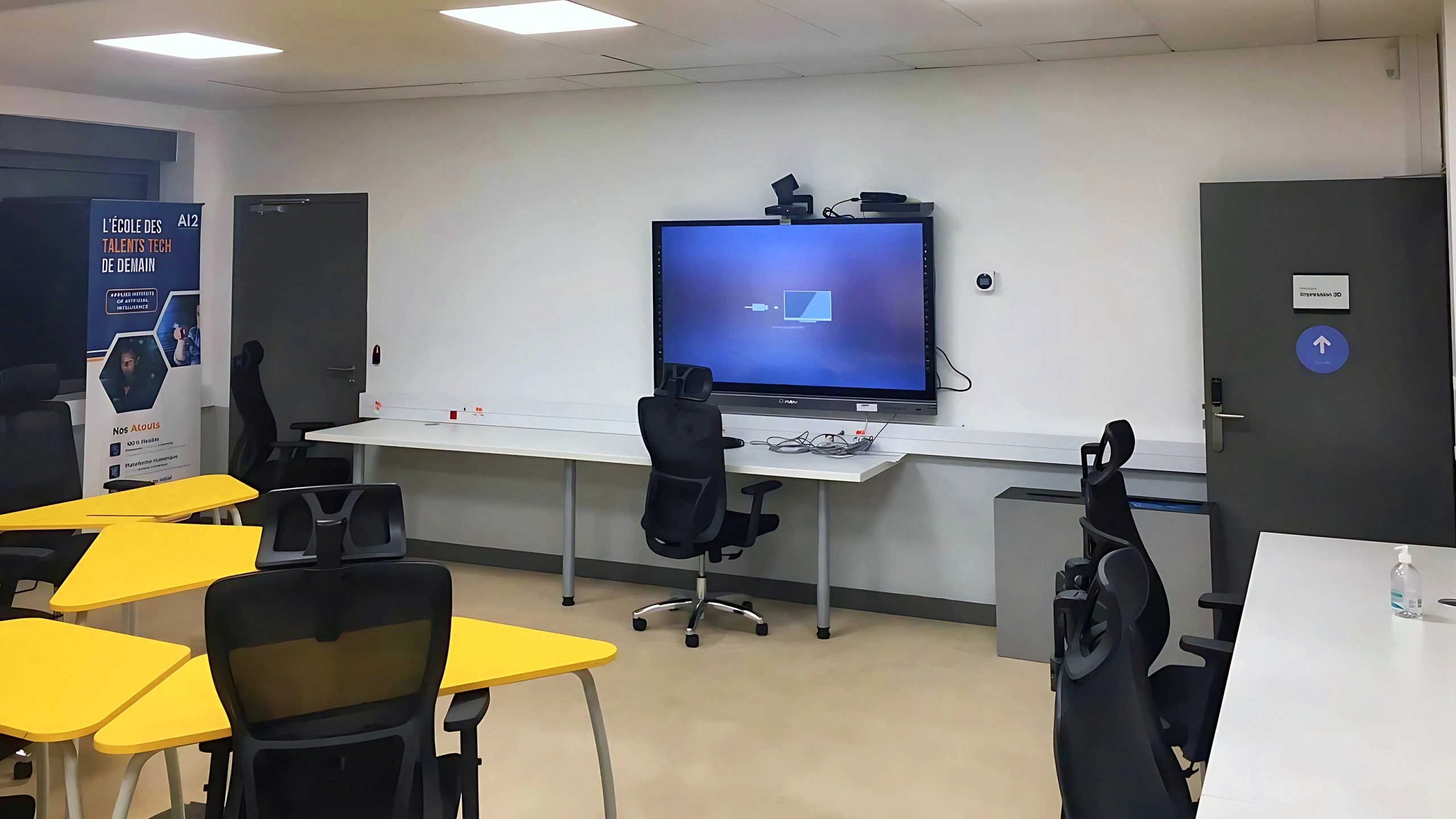
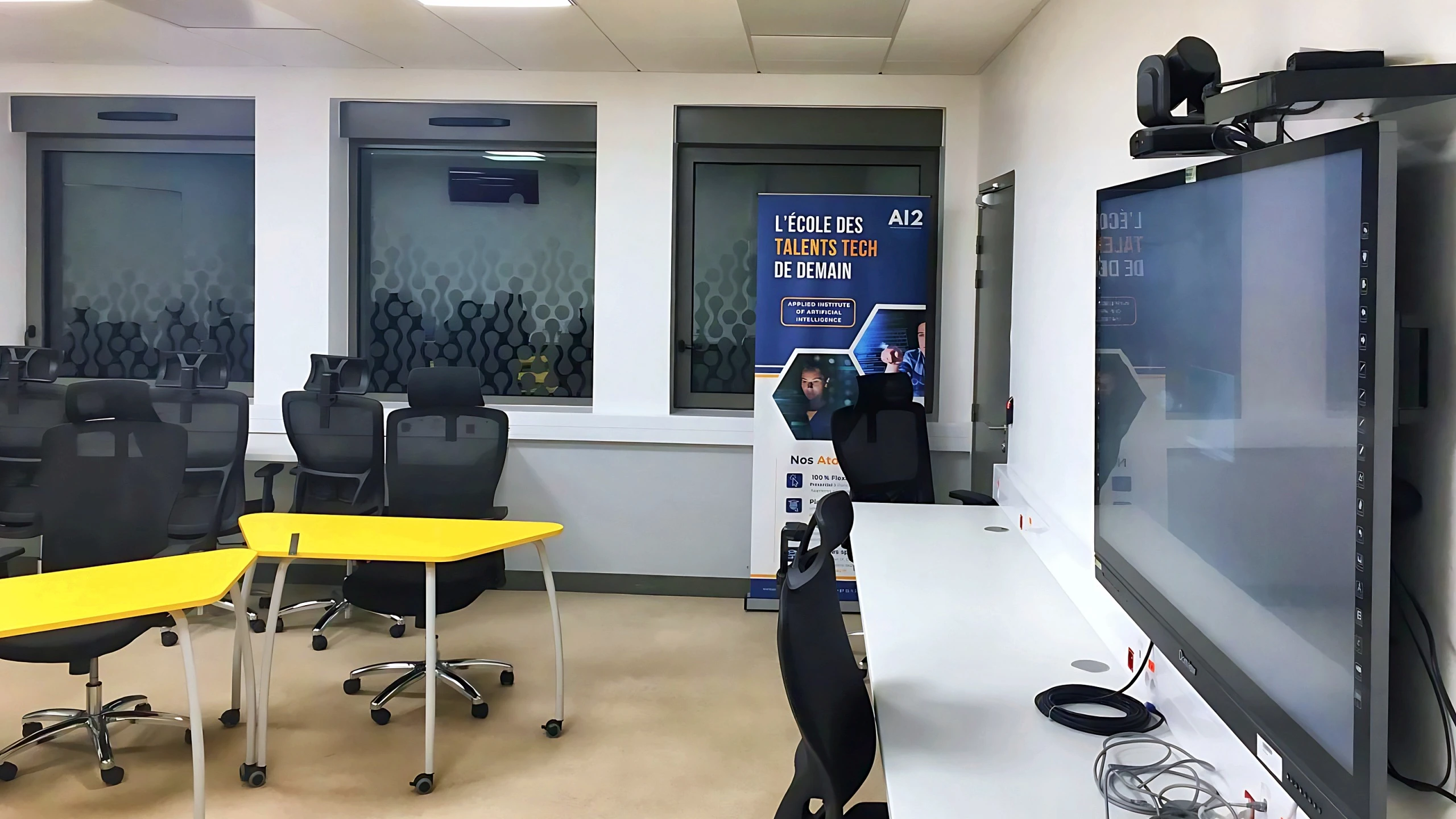
AI2, the Applied Institute of Artificial Intelligence, is a private institution on the Hub Nikola Tesla campus in Écouen, 22 minutes from Paris Gare du Nord by Transilien line H. Every course, exam and jury defence is in English, the required level is B2 (IELTS 6.0, TOEFL iBT 72 or equivalent), French is not required and optional French classes are offered. Selection is a file review and an online interview, with no GRE or GMAT. See also AI courses in Paris.
Three MSc formats cover different starting points:
- MSc, 2 years after a three-year bachelor’s: a shared applied-AI Year 1, then a Data Science, Cybersecurity or IoT specialisation and a six-month internship. Year 1 is €12,500, from €10,500 after the conditional AI2 scholarship.
- Direct entry, 18 months for a related four- or five-year degree: 12 months on campus, then a six-month internship. €13,000, from €11,300 after scholarship (IoT from €11,800).
- Fast-Track, 11 months, February 2027 only, for engineers and master’s holders: five months on campus, then six months in a company in France. €11,000 for applications before 15 November 2026, then €12,500.
Intakes are planned in February, May and September 2027, and the priority deadline for February is 30 November 2026. Each final year awards the AI2 diploma and prepares a professional certification recognised by the French State and registered at RNCP level 7, the master’s level (EQF 7): RNCP39978 for the Data Science and Cybersecurity tracks, RNCP40554 for IoT. AI2’s programme pages state that RNCP level 7 titles appear on the official list of diplomas at least equivalent to a master’s for residence purposes, which opens the main post-study routes; as for every permit, the préfecture decides.
From MSc Year 2, work-study lets an employer’s training fund pay tuition while you earn a salary, once you find an employer. See AI2 tuition fees 2027, the MSc Applied AI and Data Science and the master’s in AI in France guide.
Frequently asked questions
Is it better to do a master’s in France or the UK?
The UK suits students who want a one-year course and 18 months of post-study work from 2027. France suits students who want lower public tuition, no immigration health surcharge, 964 work hours a year and a longer programme that includes company experience.
Is a one-year UK master’s cheaper than a two-year French master’s?
Not always. UK fees are set by each university and the visa adds a health surcharge, while a French public master’s costs €3,950 a year in 2026 to 2027. Compare the cost of the whole degree.
How much does a UK Student visa cost in total?
The application fee is £558. Students also pay a health surcharge of £776 per year of visa; for a typical one-year master’s, where the visa lasts between one year and 18 months, that is £1,164, so about £1,722 in total per person.
How many hours can I work as a student in each country?
In the UK, up to 20 hours a week in term time for degree-level students, and full time in vacations. In France, 964 hours a year without a work authorisation, spread as you choose.
How long can I stay after graduating in 2027?
The UK Graduate visa lasts 18 months for applications made from 1 January 2027, and 2 years for applications made by 31 December 2026. France grants a one-year, non-renewable job-search permit after a master’s or an equivalent diploma, with further routes such as the talent permit.
Can I bring my spouse on a master’s in the UK or France?
In the UK, not on a taught master’s that started on or after 1 January 2024, unless you are government-sponsored. In France, no dependant status is attached to the student visa: Campus France advises a separate visa for each dependant.
Do I need French to study a master’s in France?
Not for a programme taught in English. Each institution sets its own English requirement; AI2, for example, asks for B2 and teaches every course in English. French remains useful for daily life and for the job search.
Also comparing Ireland? Read France vs Ireland for a master’s.
Sources consulted on 27 October 2026: gov.uk: Student visa · gov.uk: Student visa, money you need · gov.uk: Student visa, partner and children · gov.uk: healthcare surcharge · gov.uk: Graduate visa · UKCISA: student work · UKCISA: Graduate route · UKCISA: changes to the Student and Graduate rules · UKCISA: dependants · Campus France: tuition fees · Campus France: LMD system · Campus France: Études en France · Campus France USA: students with families · Campus France India: post-study stay · Service-Public: student visa and resources · Service-Public: long-stay visa · Service-Public: work for foreign students · Service-Public: job-search permit · Service-Public: talent permit
Apply to AI2’s English-taught MSc near Paris: admissions reviews your file, holds an online interview and confirms your format, tuition and scholarship in writing.