

Search for “master’s in machine learning” in France and you will find few programmes with exactly that name. Machine learning is taught inside degrees called artificial intelligence, data science, applied mathematics, computer science or statistics. That is good news, because the choice is wider than the label suggests, and a trap, because two programmes with the same title can contain very different amounts of ML. This guide explains what a serious ML master’s covers, how research and applied routes differ, what admission looks for, what it costs, and where AI2’s applied MSc fits. For the broader picture of AI degrees, read our pillar guide to the master’s in artificial intelligence in France in English.
What does a machine learning master’s cover?
| Area | Typical content | Why it matters |
|---|---|---|
| Mathematical foundations | Linear algebra, probability, statistics, optimisation | Every model you train rests on them |
| Statistical learning | Regression, classification, trees and ensembles, cross-validation, metrics | The daily toolkit of data scientists |
| Deep learning | Back-propagation, regularisation, CNNs, RNNs, Transformers | The basis of vision and language models |
| Language and vision | NLP and embeddings, fine-tuning, detection and segmentation | Common in business and industrial uses |
| Generative AI | Large language models, retrieval-augmented generation, agents, evaluation | The core of new AI engineer roles |
| MLOps and deployment | Experiment tracking, containers, CI/CD, monitoring and drift | What separates a prototype from a product |
| Data engineering | SQL, pipelines, orchestration, data quality | Models are only as good as their data |
| Law and ethics | GDPR, EU AI Act risk classes, bias and explainability | Apply to AI systems used in the EU |
Research-oriented degrees go deeper into theory, optimisation and topics such as reinforcement learning or probabilistic models. Applied programmes spend more hours on deployment, data pipelines and business cases. Both should give you real practice: a curriculum that lists deep learning in one 20-hour course and nothing after it is an introduction, not a specialisation.
Research or applied: which route fits you?
Neither is better in general. They lead to different first jobs.
| Research-oriented route | Applied route | |
|---|---|---|
| Main goal | Prepare for research and a PhD | Prepare for an engineering or data role in a company |
| Typical content | Theory, mathematics, recent papers, advanced topics | Projects, tools, deployment, business data |
| Final stage | Research internship, often in a laboratory | Company internship or work-study, professional project |
| Qualification | Often a State master’s degree from a public university | A degree or a professional title, for example registered in the RNCP |
| Next step | Doctorate, research engineer | ML engineer, data scientist, AI engineer |
| Suits you if | You enjoy proofs and want to publish | You want to build and ship systems quickly |
If a PhD is your goal, check that the programme includes a research internship and that its graduates go on to doctoral schools. Doctoral students in France pay €398 a year in registration fees whatever their nationality, and Campus France notes that doctoral candidates apply directly to doctoral schools rather than through Études en France. If you want industry, look for long company placements, team projects on real data and MLOps hours. Our guide to data science master’s in Paris adds an eight-point checklist for applied programmes.
How to check that a programme really teaches machine learning
- 1Count the hoursAdd up the hours for machine learning, deep learning and their applications. A specialisation shows up in hundreds of hours, not a single module.
- 2Look for productionMLOps, deployment and monitoring should appear by name. APEC lists industrialising models among a data scientist’s core missions.
- 3Ask how you are assessedProjects defended before a jury, on real data, prove more than written exams alone.
- 4Check the language of everythingCourses, exams and the final defence. “Partly in English” can mean a semester in French.
- 5Check the qualificationState master’s degree, engineering diploma or a title registered in the RNCP. RNCP records, with their level and certifying body, are public on France Compétences’ website.
- 6Compare the calendarMost programmes start in September. Some schools also offer February or May starts, which changes your visa timeline.
Admission: what do you need to get in?
| Requirement | What schools usually look for |
|---|---|
| Degree | Bachelor’s in computer science, mathematics, engineering, statistics or a close science |
| Mathematics | Linear algebra, probability and statistics at undergraduate level |
| Programming | Python, ideally with NumPy and Pandas, plus SQL |
| English | Proof at B2 or above for English-taught programmes; tests and waivers vary by school |
| Application route | Études en France in the 75 countries and territories it covers, otherwise the school or university directly |
| Selection | Transcripts, statement of purpose, CV, sometimes a technical interview or test |
A frequent weak spot is mathematics. If your degree had little linear algebra or probability, fix it before you apply and say so in your statement of purpose: a short online course with a certificate, or a project where you implemented a model from scratch, shows the admissions team you can follow the pace. Not every programme asks for the GRE; see our guide to master’s in France without the GRE.
How much does a machine learning master’s cost in France?
| Programme | Tuition | Note |
|---|---|---|
| Public university master’s, EU and EEA students | €255 a year | Plus the €105 CVEC |
| Public university master’s, most non-EU students | €3,950 a year | Exemptions possible, capped per university |
| Doctorate, all nationalities | €398 a year | Funding of the research is separate |
| AI2 MSc Year 1 | €12,500 | From €10,500 after a conditional AI2 scholarship |
| AI2 MSc Year 2 or 18-month direct entry | €13,000 | From €11,300 after scholarship |
| AI2 Fast-Track, 11 months, February 2027 | €12,500 | €11,000 for applications before 15 November 2026 |
Whatever the tuition, the long-stay student visa requires proof of at least €877.50 a month for living costs, according to Service-Public. Public fees are low, but most public master’s programmes are taught in French and start in September; private programmes charge more and often add English teaching, company placements and several intakes. Full AI2 fees and scholarships are on AI2 tuition fees 2027.
What jobs does a machine learning master’s lead to?
| Role | What you do | Michael Page 2027, Paris region, gross a year |
|---|---|---|
| Machine learning engineer | Trains, deploys and monitors models in production | €65,000 average (€45,000 to €90,000) |
| AI engineer, AI developer | Builds applications on language models and agents | €63,000 average (€45,000 to €90,000) |
| Data scientist | Builds predictive models and analyses | €59,000 average, grid shared with data engineers |
| Research engineer, PhD candidate | Works on new methods in a lab or R&D team | Not covered by these grids |
The ML engineer grid is the highest of those quoted here, which matches the skill set applied programmes emphasise: taking a model to production and keeping it reliable. Junior, regional and net figures are broken down in our guide to the data scientist salary in France.
The AI2 MSc Applied AI and Data Science: an applied ML route
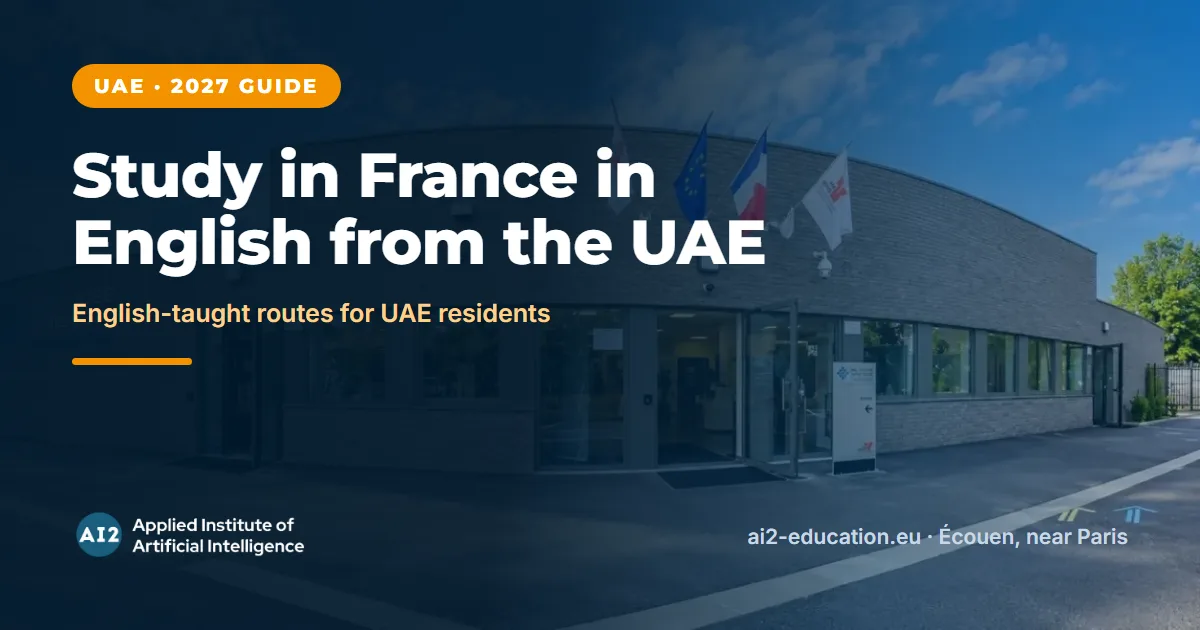
AI2’s MSc Applied AI and Data Science takes the applied side of the table above. It is taught 100% in English on the Écouen campus, 22 minutes from Paris Gare du Nord, and ends with six months in a company in France and a professional project defended before a jury. Here are its machine learning modules in the two-year route.
| Module | Hours | What you learn |
|---|---|---|
| Y1.03 Introduction to Machine Learning | 28 h | Cross-validation, metrics, Random Forest, XGBoost, SHAP |
| Y1.06 Machine Learning Project | 21 h | Team business case, five or more models compared, jury defence |
| Y1.12 NLP and Industrial Text Mining | 21 h | Tokenisation, TF-IDF, embeddings, classification |
| Y1.14 Introduction to Deep Learning | 21 h | Back-propagation, regularisation, first CNN, transfer learning |
| Year 2: NLP and Transformers | 42 h | Embeddings, Transformer architectures, fine-tuning |
| Year 2: Advanced Computer Vision | 42 h | CNNs and vision Transformers, detection, segmentation |
| Year 2: Generative AI and Agents | 42 h | LLMs, RAG, autonomous and multi-agent systems, guardrails |
| Year 2: MLOps | 42 h | Model lifecycle, experiment tracking, deployment, monitoring, drift, CI/CD |
The 11-month Fast-Track, for engineers and master’s holders starting in February 2027, condenses the same core into five months on campus: 42 hours each of machine learning, deep learning with PyTorch, and generative AI and agents, 35 hours of NLP and computer vision, and 28 hours of MLOps, alongside the four certification blocks.
Holders of a three-year bachelor’s join the two-year MSc; holders of a related four- or five-year degree can enter Year 2 directly for an 18-month route. Admission is based on your file and an online interview, with B2 English and no GRE or GMAT. Intakes run in February, May and September 2027. The final year awards the AI2 diploma and prepares RNCP39978 “Architecte des systèmes d’information dans les processus industriels”, a professional certification recognised by the French State at level 7, the master’s level, certified by DATAKOO, AI2’s parent company.
📘 Related guide: AI security careers: protecting AI systems, skills and roles.
📘 Related guide: Machine learning engineer careers in France: from models to production.
📘 Related guide: One-year masters in France: options, visa rules and the 11-month Fast-Track.
Frequently asked questions
Can I study a master’s in machine learning in France in English?
Yes. Campus France lists more than 1,600 programmes taught wholly or partly in English. Machine learning is usually taught inside AI, data science or applied mathematics master’s, so search by content rather than by title.
How much does a machine learning master’s cost in France?
Public universities charge €3,950 a year to most non-EU students and €255 to EU students in 2026-27. Private programmes cost more: AI2’s MSc Year 1 is €12,500, or from €10,500 after a conditional scholarship.
What background do I need for a machine learning master’s?
Usually a bachelor’s in computer science, mathematics, engineering or a close science, with linear algebra, probability, statistics and Python. English-taught programmes also ask for proof of English at about B2.
Should I choose a research or an applied machine learning master’s?
Choose research if you aim for a PhD or a research engineer role, and an applied programme if you want an ML engineer or data scientist job in a company soon after graduating.
What salary can I expect after a machine learning master’s in France?
Michael Page’s 2027 grid gives machine learning engineers in the Paris region €45,000 to €90,000 gross a year, with an average of €65,000. First jobs sit at the lower end of that range.
Do I need the GRE for a machine learning master’s in France?
It depends on the school, so check each admission page. AI2 admits on the basis of your application file and an online interview, without GRE or GMAT.
Which machine learning modules does the AI2 MSc include?
Machine learning, deep learning, NLP and Transformers, computer vision, generative AI and agents, and MLOps, plus data engineering and a six-month company internship.
Sources consulted on 27 October 2026: Campus France: finding the programme for you (updated 22 January 2026) · Campus France: tuition fees 2026-27 (updated 25 June 2026) · Service-Public: registration fees 2026-27 (verified 20 August 2026) · Campus France: Études en France procedure (updated 28 September 2026) · Service-Public: student visa resources (verified 1 August 2026) · Michael Page: Étude de rémunérations 2027, machine learning engineer · APEC: data scientist job sheet · France Compétences: RNCP39978 record
Apply online for the MSc Applied AI and Data Science: admissions reviews your file, holds an online interview and confirms your format, tuition and any AI2 scholarship in writing.