

Want to be the person who takes machine-learning models from a notebook to production in France? What the job really involves, how it differs from data science, what the EU AI Act adds to the work, what it pays and a realistic route from student to first contract.
What does a machine learning engineer do?
The short answer: they make models work outside the notebook, at scale, every day.
France Travail, the French public employment service, describes the machine learning engineer as the person who designs, trains and optimises machine-learning models, and calls the role one of the profiles companies ask for most in their AI projects. The tools it lists are a good summary of the job: Python, TensorFlow, PyTorch, MLflow and Kubernetes.
In practice the ML engineer sits between the data scientist, who explores data and proves that a model is worth building, and the operations side, which has to run it. A typical week mixes code reviews, feature pipelines, training runs, deployment through an API or a batch job, and dashboards that show whether the model is drifting.
| Role | Main output | Typical day | Core tools |
|---|---|---|---|
| Data scientist | Analyses and models that answer a business question | Exploring data, testing hypotheses, presenting results | Python, SQL, statistics, notebooks |
| Machine learning engineer | Models that run reliably inside a product or process | Training pipelines, serving, testing, performance tuning | Python, PyTorch or TensorFlow, MLflow, Docker |
| MLOps engineer | The platform that deploys and monitors models | CI/CD for models, monitoring, retraining, infrastructure | Kubernetes, CI/CD, cloud services, monitoring tools |
| Data engineer | Clean, timely data for analytics and models | Building and maintaining ETL or ELT pipelines | SQL, Airflow, Kafka, dbt, cloud warehouses |
If you are still choosing between the two neighbouring careers, our comparison of data science and artificial intelligence explains where the boundaries sit, and the companion guide on how to become a data scientist in France covers the analysis side of the work.
Is there demand for machine learning engineers in France?
Yes, with a nuance for beginners.
Apec, the French association for executive employment, published its hiring forecast in April 2026 from a survey of a permanent sample of 8,100 private-sector companies. Its findings are mixed, and worth reading as a whole:
- French companies recruited 294,500 executives in 2025, down 3% on 2024 and 11% below the 2023 record of 330,400.
- For 2026 Apec expects a rebound to 305,800 executive hires (+4%), a forecast it says is subject to major uncertainties.
- IT executives would remain the most sought-after profiles, with 61,160 planned hires (+4%). Apec links this demand to digital transformation, stronger cybersecurity and the rise of artificial intelligence.
- Hiring of executives with less than six years of experience would grow by only 1%, to about 137,600, still well below 2023 (157,100). Employers prefer candidates who are operational quickly.
Eurostat adds the European picture. In 2025, 20.0% of EU enterprises with at least ten employees used AI technologies, against 13.5% in 2024. Adoption reached 55.03% in large enterprises and 62.52% in the information and communication sector. Among companies that had considered AI but did not use it, 70.89% cited a lack of relevant expertise: the skills an ML engineer brings.
How does the EU AI Act change the job?
The EU AI Act entered into force on 1 August 2024. According to the European Commission’s policy page (last updated 19 October 2026), prohibited practices and AI literacy obligations have applied since 2 February 2025, obligations for general-purpose AI models since 2 August 2025, and the Act became applicable on 2 August 2026 with exceptions. Following the political agreement on simplifying the Act, strict obligations for high-risk systems in the Annex III areas start on 2 December 2027, and high-risk systems embedded in regulated products have until 2 August 2028.
Most of those obligations are engineering work. The Commission lists them, and each one maps onto something an ML engineer builds:
| AI Act requirement for high-risk systems | What the ML engineer builds |
|---|---|
| Adequate risk assessment and mitigation systems | Test suites, failure analysis, fallback behaviour |
| High-quality datasets to minimise discriminatory outcomes | Data validation, bias checks, documented training data |
| Logging of activity to ensure traceability of results | Prediction logs, model and data versioning |
| Detailed documentation on the system | Model cards, pipeline documentation, experiment tracking |
| Clear and adequate information to the deployer | Usage notes, known limits, performance reports |
| Appropriate human oversight measures | Review queues, confidence thresholds, override paths |
| High level of robustness, cybersecurity and accuracy | Monitoring, drift detection, security testing, retraining |
That is why experiment tracking, versioning and monitoring now matter in interviews as much as model accuracy.
Which skills does a machine learning engineer need?
Engineering first, models second: that is what separates the role from pure data science.
| Skill area | What employers check | How to build it as a student |
|---|---|---|
| Python and software engineering | Clean, tested, reviewed code; Git; packaging | Contribute to a shared repository, write unit tests for your pipelines |
| Machine learning and deep learning | Choosing, training and evaluating models; PyTorch or TensorFlow | Reproduce a known result, then improve it on a new dataset |
| Data pipelines | SQL, orchestration, data quality checks | Build a small ELT pipeline with a scheduler feeding a model |
| MLOps | Experiment tracking, Docker, CI/CD, monitoring and drift | Deploy one model behind an API and monitor it for a month |
| Language models | RAG, fine-tuning, evaluation and guardrails | Build a retrieval application on documents you know well |
| Regulation and ethics | GDPR, AI Act risk classes, explainability | Write a short compliance note for one of your own projects |
France Travail notes that for technical profiles, a master’s in data science or an engineering degree remains a differentiating asset. A portfolio counts too: two or three projects that are deployed, documented and monitored say more than a long list of online courses.
How much does a machine learning engineer earn in France?
Use salary ranges as orientation, and the legal thresholds as hard limits for your visa plans.
Published salary figures for ML engineers in France vary widely by source, city and seniority, and most come from recruitment firms rather than official statistics. Our dedicated guide to data scientist and ML engineer salaries in France compares them. Two reference points are useful here:
| Reference point | Amount | Source |
|---|---|---|
| ML engineer, Paris region (indicative range) | €45,000 to €90,000 gross a year, average €65,000 | AI2 programme page, read 29 October 2026 |
| Minimum internship pay (placements over two months) | €4.50 an hour, €661.50 for a 147-hour month | Service-Public F32131, verified 1 January 2026 |
| Minimum pay for a job held with the job-search permit | more than €2,800.53 gross a month, in a job related to your studies | Service-Public F17319, verified 1 June 2026 |
| Talent permit, qualified employee route | €39,582 gross a year or more, with a master’s-level diploma obtained in France | Service-Public F16922, verified 1 June 2026 |
| Talent permit, EU Blue Card | €59,373 gross a year or more | Service-Public F16922, verified 1 June 2026 |
How to become a machine learning engineer in France: a step-by-step roadmap
A route that works for most international students, from first project to first contract.
- 1Secure the foundationsPython, linear algebra, probability and SQL. Most technical interviews for junior ML roles start with code and data questions, not with deep learning theory.
- 2Learn to train and evaluate models properlyCross-validation, the right metrics, error analysis and interpretation. Being able to explain why a model fails is a core ML engineering skill.
- 3Move from notebooks to softwareVersion control, tests, packaging, Docker and a REST API. Rebuild one notebook project as a small service.
- 4Add MLOps and cloudExperiment tracking, a model registry, CI/CD and monitoring for drift. Deploy on a cloud platform and keep the system running.
- 5Choose a master’s with a long company placementLook for modules in deep learning, MLOps and generative AI, a placement of several months and a teaching language you master. Check the RNCP level and the intake dates against your visa timeline.
- 6Get production experience during your studiesAn internship of more than two months is paid at least €4.50 an hour in 2026. A work-study contract in the final year gives you a salary and a year of real projects.
- 7Turn the placement into a contractTeams often hire the intern who already knows their stack. After graduation, the job-search permit gives one year to find a job related to your studies; see our guide to working in France after graduation.
What changes for international students?
Working while you study
Language at work
Proof of funds for the visa
After a master’s-level diploma obtained in France, the job-search or business-creation permit gives you one year to find a job related to your studies, without the 964-hour limit (Service-Public F17319). If you want a faster academic route, our guide to one-year master’s options in France explains what “one year” means for the visa and for this permit.
Where does AI2’s MSc fit for a future ML engineer?
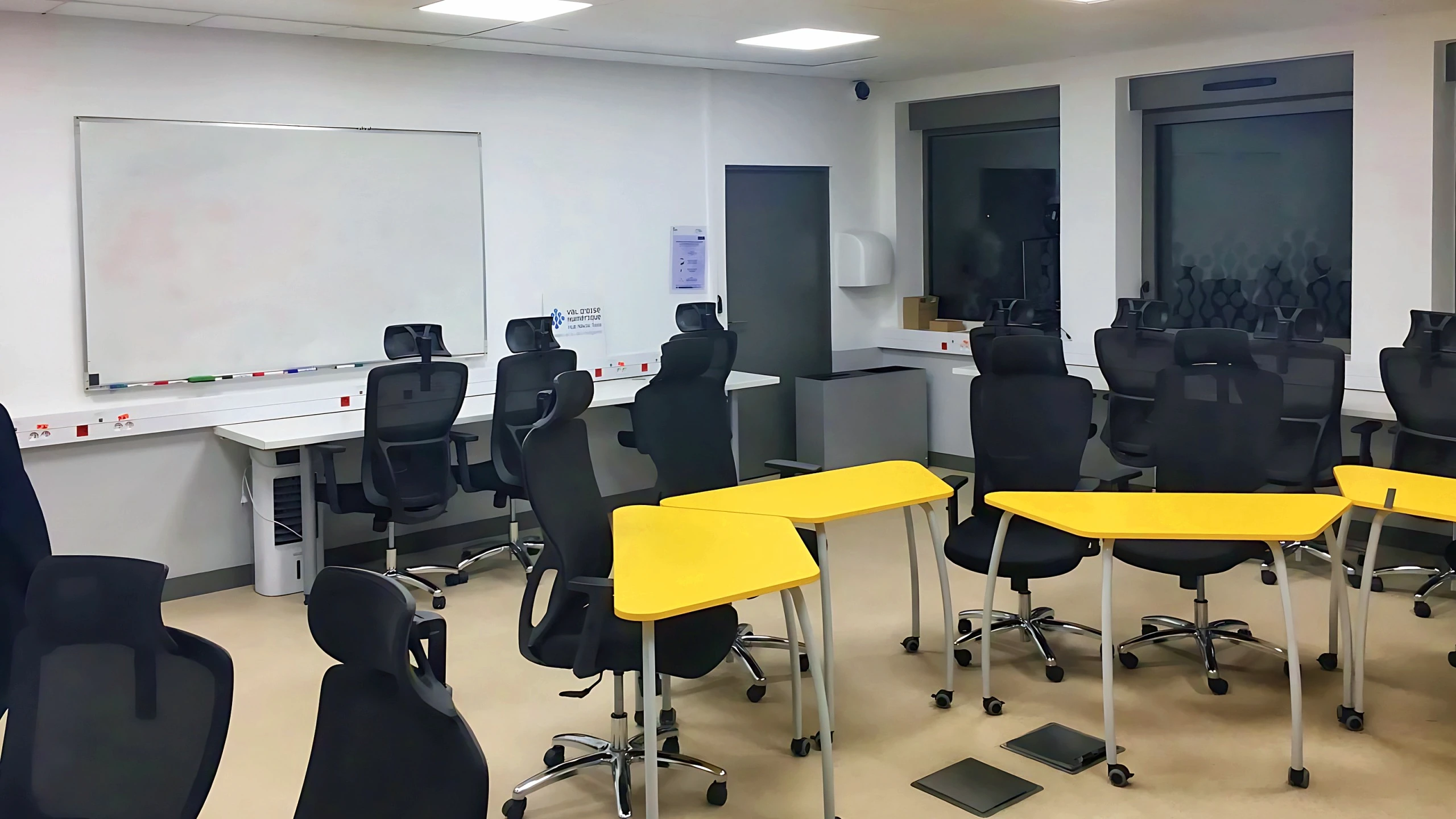
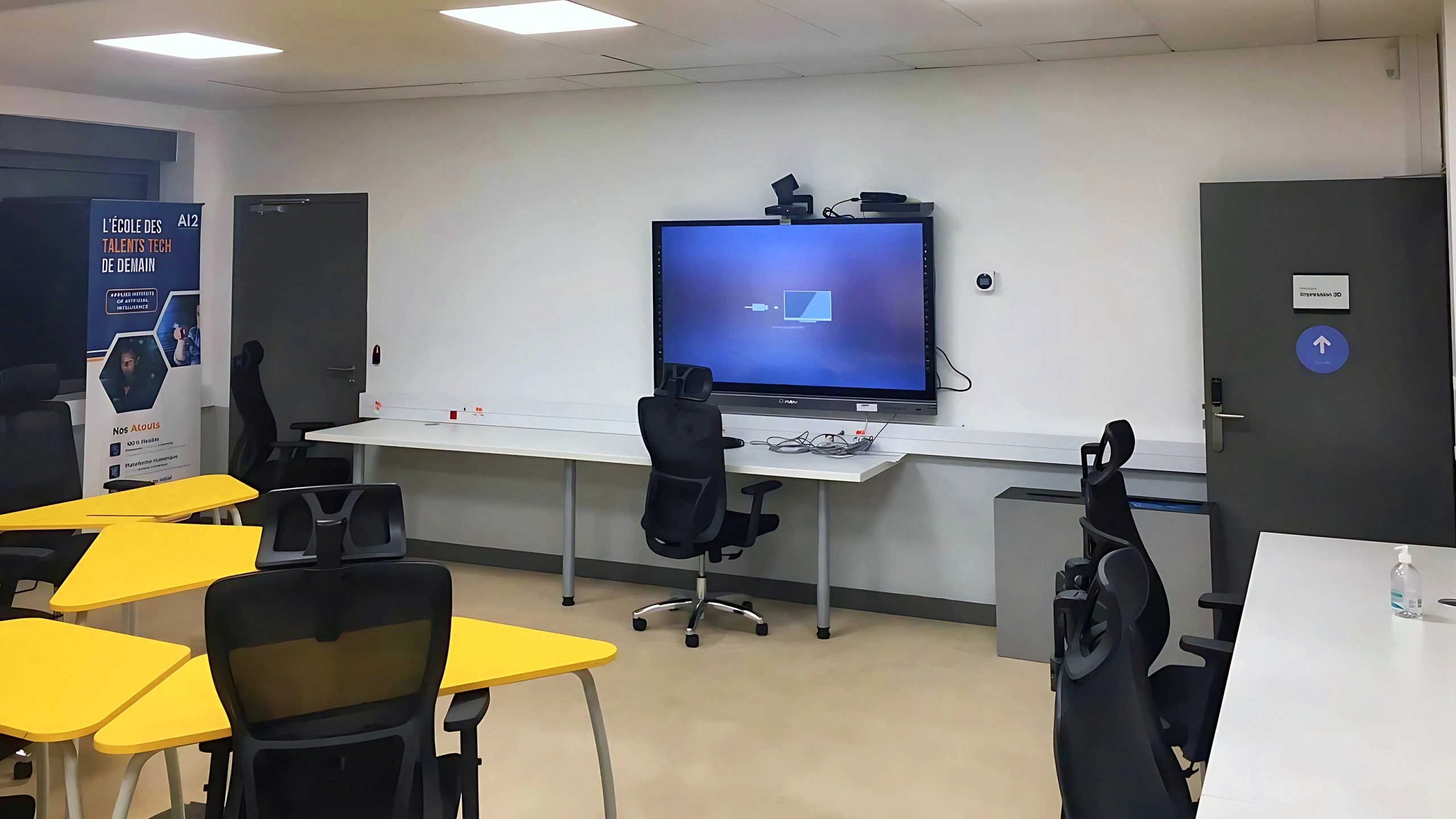
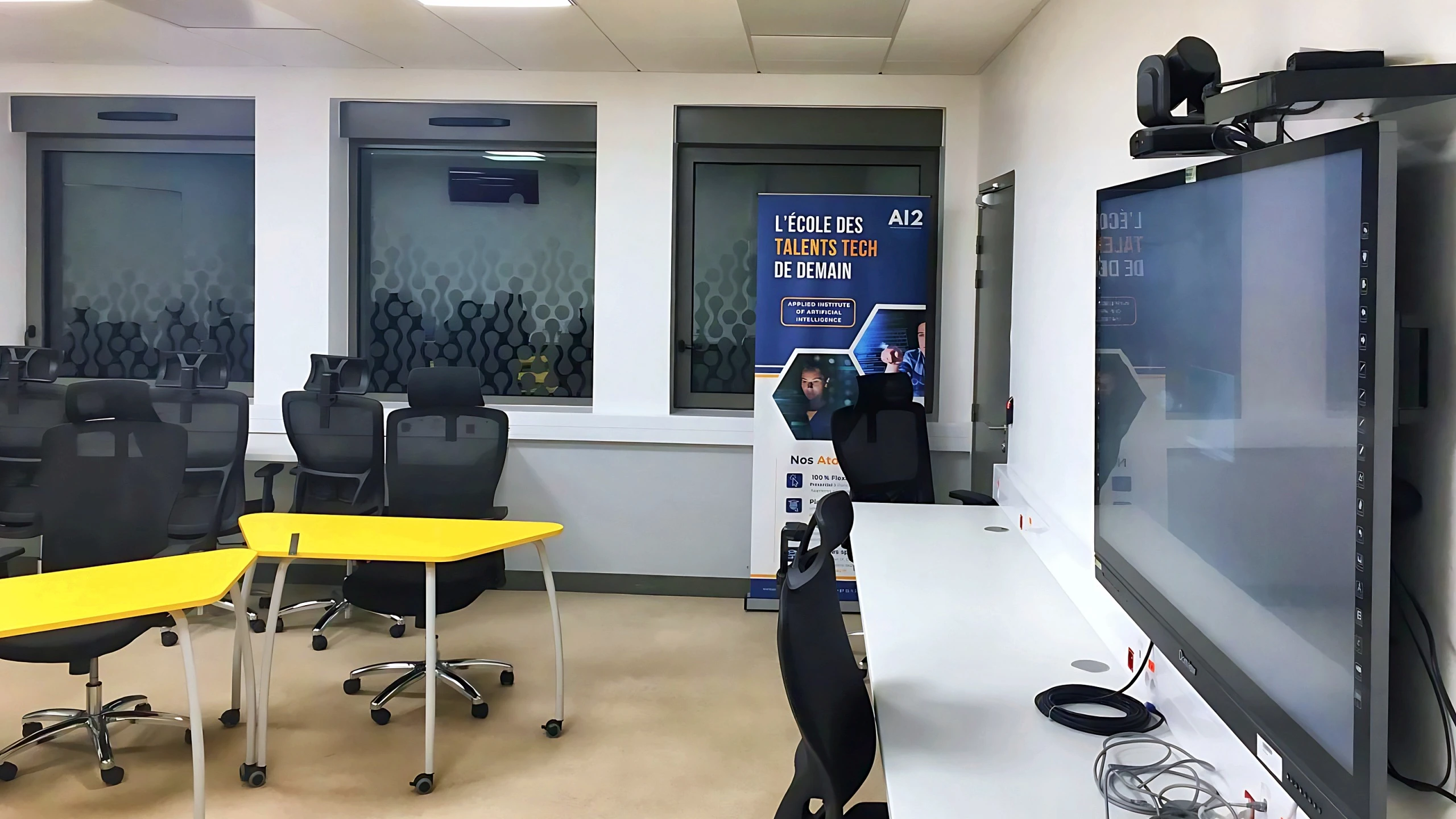
AI2, the Applied Institute of Artificial Intelligence, teaches its MSc 100% in English (B2 level, for example IELTS 6.0 or TOEFL iBT 72; no French and no GRE or GMAT required) on its campus at the Hub Nikola Tesla in Écouen, 22 minutes from Paris Gare du Nord by Transilien line H. The MSc Applied AI and Data Science lists machine-learning engineer among its career directions and is built around the production skills described above.
| What the ML engineer job asks for | Where it is taught in the AI2 MSc | Volume |
|---|---|---|
| Model lifecycle, deployment, monitoring | MLOps: experiment tracking, deployment, monitoring and drift, CI/CD for machine learning | 42 h |
| Language models in production | Generative AI & Agents: LLMs, RAG architectures, autonomous and multi-agent systems, evaluation and guardrails | 42 h |
| Deep learning for text and images | NLP & Transformers and Advanced Computer Vision tracks | 2 × 42 h |
| Industrial ML and explainability | Block 4, Data & AI innovation: industrial ML and deep learning, predictive maintenance, ethics and explainability | 56 h |
| Data pipelines and cloud (Year 1) | Data Engineering & Pipelines (Airflow, Kafka, dbt) and Cloud Computing on AWS and Azure | 28 h + 21 h |
The final year awards the AI2 diploma and prepares the professional certification RNCP39978 « Architecte des systèmes d’information dans les processus industriels » (certifier DATAKOO, AI2’s parent company), registered in the RNCP at level 7: a qualification recognised by the French State at master’s level (EQF 7). Work-study may be possible in Year 2 with an employer contract.
| Format | Entry level | Tuition 2027 |
|---|---|---|
| MSc 2 years (Year 1 applied AI core, Year 2 data science, then 6-month internship) | Three-year bachelor’s in computing, mathematics, engineering or science | Year 1 €12,500, from €10,500 after scholarship; Year 2 €13,000 |
| Direct entry, 18 months (12 months on campus, 6-month internship) | Related four- or five-year degree, subject to academic review | €13,000, from €11,300 after scholarship |
| Fast-Track February, 11 months (5 months on campus, 6-month internship) | Four-year accredited B.Tech or BE, or a master’s; Python, statistics and SQL checked at interview | €12,500, or €11,000 for applications before 15 November 2026 |
Intakes are planned in February, May and September 2027; the Fast-Track exists only for February 2027. For February, the priority deadline and complete visa file are due on 30 November 2026, and enrolment with deposit on 15 December 2026. Full fee details are on the AI2 tuition fees page, and our guide to data science master’s near Paris taught in English compares the wider options. Modules, faculty and admission documents are on the MSc Applied AI and Data Science programme page.
Frequently asked questions
What does a machine learning engineer do in France?
A machine learning engineer designs, trains and optimises models, then deploys them in products or processes and keeps them reliable through monitoring and retraining. France Travail describes it as one of the profiles companies ask for most in their AI projects, with tools such as Python, TensorFlow, PyTorch, MLflow and Kubernetes.
What degree do you need to become an ML engineer in France?
No single diploma is mandatory, but France Travail notes that a master’s in data science or an engineering degree remains a differentiating asset for technical profiles. Employers also expect proof of production experience, such as an internship, a work-study contract or deployed projects.
What is the difference between a data scientist and an ML engineer?
The data scientist analyses data and builds models that answer business questions. The ML engineer turns those models into reliable software: pipelines, deployment, testing and monitoring. In small companies one person often does both; larger employers separate the roles.
Are ML engineers in demand in France?
Apec’s April 2026 forecast puts IT executives first among planned hires, with 61,160 recruitments expected in 2026 (+4%), and cites the rise of artificial intelligence as a driver. Hiring of executives with less than six years of experience is expected to grow by only 1%, so practical experience matters for beginners.
How does the EU AI Act affect ML engineers?
High-risk AI systems must have risk mitigation, quality datasets, activity logging, documentation, human oversight and a high level of robustness, cybersecurity and accuracy. According to the European Commission, these obligations apply to Annex III high-risk systems from 2 December 2027, and much of the work falls to ML engineers.
Which AI2 programme prepares for an ML engineer career?
The MSc Applied AI and Data Science, which includes 42-hour modules in MLOps and in Generative AI and Agents, deep learning tracks and a six-month internship. It is offered in 2 years, 18 months direct entry, or an 11-month Fast-Track starting in February 2027.
Sources consulted on 29 October 2026: France Travail: Les métiers de la data (ML engineer and MLOps profiles) · Apec: Prévisions de recrutements de cadres 2026 (April 2026, PDF) · Eurostat: 20% of EU enterprises use AI technologies (11 December 2025) · Eurostat: Use of artificial intelligence in enterprises, Statistics Explained (data extracted December 2025) · European Commission: AI Act policy page (last update 19 October 2026) · Service-Public: internship gratification, F32131 (verified 1 January 2026) · Service-Public: work for foreign students, F2713 (verified 7 October 2025) · Service-Public: student visa and residence permit, F2231 (verified 1 August 2026) · Service-Public: job-search or business-creation permit, F17319 (verified 1 June 2026) · Service-Public: talent permit, F16922 (verified 1 June 2026) · AI2: MSc Applied AI and Data Science · AI2: tuition fees 2027
Apply online: AI2’s admissions team reviews your transcripts, holds an online interview and confirms your entry route, tuition and any scholarship in your admission letter. Priority deadline for February 2027: 30 November 2026.