
IoT sits where hardware, networks, cloud and data meet. A good master’s in the Internet of Things trains you across all four, with real devices on the bench and security built in from the start. Here is what IoT engineers do, the skills to look for, how studying IoT in France works in English, and what it costs.
What does an IoT engineer actually do?
A useful official description of the job in France is the national register entry for the professional title “Architecte Internet des objets (IoT)”, RNCP40554, published by France Compétences. It describes a professional who plans, develops, manages and supervises connected systems while keeping them interoperable, secure and efficient. The activities it lists fall into five stages:
- 1Define the projectAnalyse business needs and technical constraints, identify risks, plan resources and budget, and check the project against ethical requirements and future growth.
- 2Design the architectureBuild modular, scalable and secure IoT architectures, then select and integrate heterogeneous connected objects: sensors, actuators and gateways.
- 3Build and deploy the platformDevelop a scalable, interoperable platform, manage devices (provisioning, monitoring, updates) and deploy it in the cloud, on premises or in a hybrid setup, while protecting the quality and confidentiality of the data.
- 4Supervise and optimiseSet up monitoring tools, analyse performance and availability, detect and fix incidents, and improve scalability over time.
- 5Turn data into decisionsCollect and prepare IoT data, apply statistics and machine learning to extract useful information, and define data governance policies that users understand.
The same record names the sectors where this work happens: information and communication technology companies (IoT solution providers, connected-hardware makers and platform developers), Industry 4.0, where connected machines are monitored in real time and maintenance becomes predictive, and smart cities, from street lighting and water management to transport and security. Its summary adds connected health.
| Job title listed in RNCP40554 | What the role covers |
|---|---|
| IoT architect | Designs and plans IoT infrastructures for connectivity, interoperability and security |
| IoT engineer | Develops and implements IoT solutions that integrate connected objects and data systems |
| IoT consultant | Advises companies on adopting and optimising IoT technologies |
| IoT project manager | Coordinates teams and keeps technical and financial objectives on track |
| IoT security expert | Protects IoT infrastructures and data against cyber threats |
| IoT integration engineer | Plugs IoT solutions into existing systems without breaking compatibility or performance |
The skills an IoT master’s should teach
IoT programmes differ in emphasis: some come from electronics, others from computer science or networks. Whatever the starting point, an employer will expect you to handle every layer of a connected system well enough to talk to the specialists on each side. Use this grid to read a curriculum.
| Layer | What you should be able to do | Typical tools and standards |
|---|---|---|
| Devices and edge | Wire and program sensors and actuators, run code on microcontrollers and gateways, deploy small models at the edge | ESP32 or similar boards, Raspberry Pi gateways, embedded C or MicroPython, TensorFlow Lite |
| Connectivity | Pick a radio and a protocol for range, power and data rate; integrate them end to end | BLE, Zigbee, LoRaWAN, NB-IoT, LTE-M, Wi-Fi; MQTT, OPC UA |
| Platform and cloud | Build back ends and APIs, provision and update devices remotely, run services in containers | AWS IoT or Azure IoT, REST APIs, Docker, Kubernetes, infrastructure as code |
| Data and AI | Store time series, build pipelines, detect anomalies, predict failures | InfluxDB, Airflow, Python, scikit-learn |
| Security and compliance | Secure devices, links and platforms; document risks; apply EU rules | OWASP IoT Top 10, TLS, GDPR, NIS2, Radio Equipment Directive, Cyber Resilience Act |
| Operations and project | Monitor fleets, handle incidents, cost a project and present it | Prometheus, Grafana, ELK stack; CAPEX, OPEX and TCO budgets |
Two signals separate a hands-on IoT master’s from a theoretical one: a hardware kit you actually use, and projects that go all the way from a sensor reading to a dashboard or an alert in the cloud. If a programme cannot show you both, ask why.
Why security and regulation now sit at the core of IoT
Connected products are moving under stricter European rules, and IoT teams in France work inside that framework. The RNCP40554 record already lists the main texts an IoT architect must apply: the GDPR for personal data, the NIS rules for the security of networks and information systems in critical sectors such as energy and transport, and the Radio Equipment Directive for wireless devices.
The newest layer is the EU Cyber Resilience Act. According to the European Commission, it sets mandatory cybersecurity requirements for products with digital elements, covering their planning, design, development and maintenance, and asks manufacturers to handle vulnerabilities across the product’s life. Compliant products carry the CE marking. The Act entered into force on 10 December 2024; reporting obligations apply from 11 September 2026, when manufacturers must report actively exploited vulnerabilities, and the main obligations apply from 11 December 2027. The Commission published practical guidance for manufacturers on 27 July 2026.
For a student, this means an IoT master’s that treats security as an optional module is out of step with the market you will enter. If security is your main interest, compare with cybersecurity master’s programmes in France taught in English.
Where can you study IoT in France in English?
Three kinds of institutions offer IoT-related master’s programmes. They differ in the diploma they award, the language of teaching and the price.
Public universities
They award the national master’s degree. Campus France describes it as four semesters and 120 ECTS credits after a 180-credit bachelor’s, so two years. For students from outside the EU, the 2026 to 2027 fee at institutions under the higher education ministry is €3,950 a year. IoT topics may sit inside master’s programmes in networks, embedded systems or computer science, and the language of teaching varies from one programme to the next, so check it before you apply.
Engineering schools
Some offer connected-systems specialisations within an engineering degree or a specialised master’s. Campus France notes that schools overseen by other ministries, such as the economy or the armed forces, charge their own tuition rates, so look at each school’s published fees.
Private institutes
Campus France puts annual tuition at private institutions at about €6,000 to €18,000 or more, and says roughly 21% of students in France attend one. Some private institutes prepare professional titles registered in the RNCP, the French national register of professional certifications; a level 7 title sits at master’s level (EQF 7). Formats are often more applied, with fixed company periods and several intakes a year. See RNCP level 7 explained.
| Criterion | Public university | Engineering school | Private institute |
|---|---|---|---|
| What you receive | National master’s degree | Engineering degree or school diploma | School diploma, often with an RNCP-registered title |
| Usual length | Two years (120 ECTS) | Depends on the programme | Set by the programme; some run shorter formats |
| Tuition for non-EU students | €3,950 a year in 2026 to 2027 | Set by the school or its ministry | About €6,000 to €18,000 or more a year |
| Teaching language | Varies by programme | Varies by programme | Fully English-taught options exist |
| Company time | Internship, length set by the programme | Internships, sometimes work-study | Often a fixed internship or work-study period |
If you are still deciding between IoT and a broader degree, our guide to English-taught computer science master’s in France covers the wider options.
What are the entry requirements?
Each institution sets its own admission rules, but the pattern for an English-taught IoT master’s is consistent:
- 1A relevant bachelor’s degreeComputer science, electronics, electrical engineering, networks or telecommunications. A three-year degree usually leads to a two-year master’s; some institutions let four- or five-year graduates join directly in the second year.
- 2Programming and networking basicsPython or C, Linux, IP networking and some electronics. A small hardware project on your CV, even a home sensor build, helps a lot.
- 3English at around B2Usually shown by IELTS, TOEFL or an equivalent; some institutions accept a medium-of-instruction letter. French is generally not required for an English-taught programme.
- 4The student visaResidents of 72 countries apply through the Études en France platform, the others through France-Visas. Service-Public asks for resources of at least €877.50 a month, and within three months of arrival you validate the visa online and pay €100.
- 5Health cover on arrivalCampus France states that registering with French social security is free and mandatory for students, done online at etudiant-etranger.ameli.fr after your enrolment.
A checklist to compare IoT programmes
- Hardware: which boards, gateways and radios will you use, and do you get your own kit?
- Protocols: are LPWAN technologies such as LoRaWAN or NB-IoT covered, as well as industrial ones such as OPC UA?
- Cloud: do projects run on a real IoT cloud service, with device provisioning and updates?
- Security and regulation: is there assessed work on device security, the GDPR, NIS2 and the Cyber Resilience Act?
- Data and AI: do you build pipelines and models on sensor data, such as anomaly detection or predictive maintenance?
- Company time: how long is the internship, who signs the agreement, and is work-study possible?
- Qualification: national master’s, engineering degree or RNCP title, and at which level?
- Calendar and cost: which intakes, what total tuition for the whole programme, and what scholarships?
After graduation: staying in France
Service-Public describes a one-year, non-renewable job-search or business-creation permit for non-EU graduates who obtained a master’s or another diploma at least equivalent to a master’s in France within the last 12 months. During that year, a job linked to your studies paid more than €2,800.53 gross a month needs no work authorisation. With a qualifying job you then move to a salaried permit, or to a multi-year talent card for qualified employees from €39,582 gross a year. Graduates who have left France can still apply within four years of the diploma. Read more on working in France after graduation.
Where AI2 fits: the MSc Applied AI & IoT
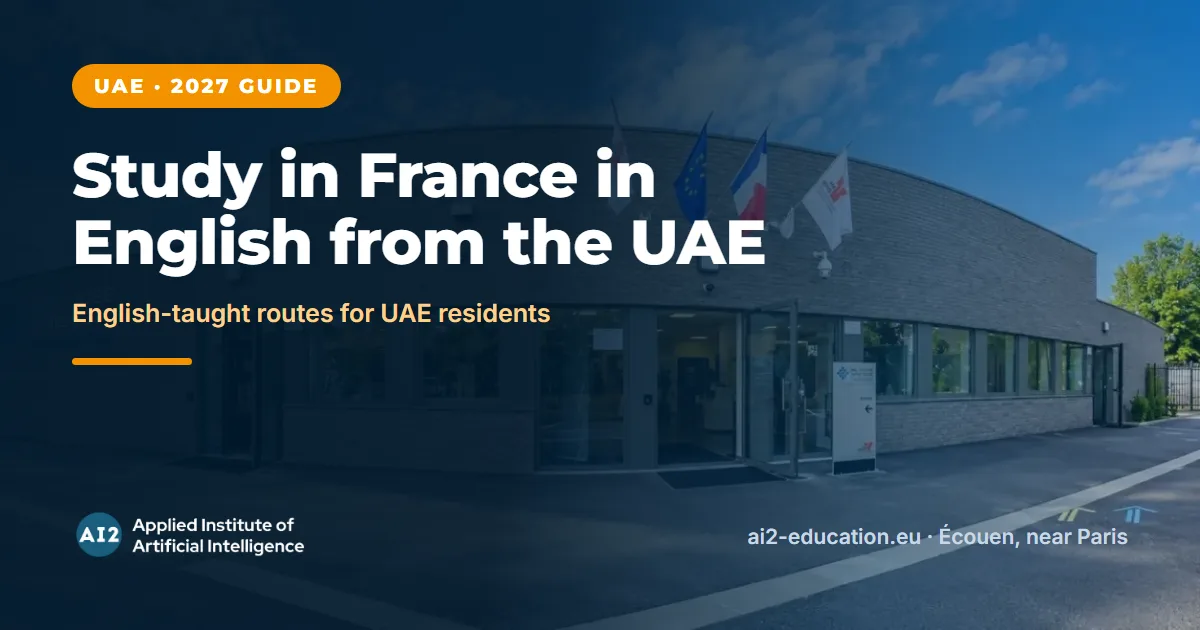
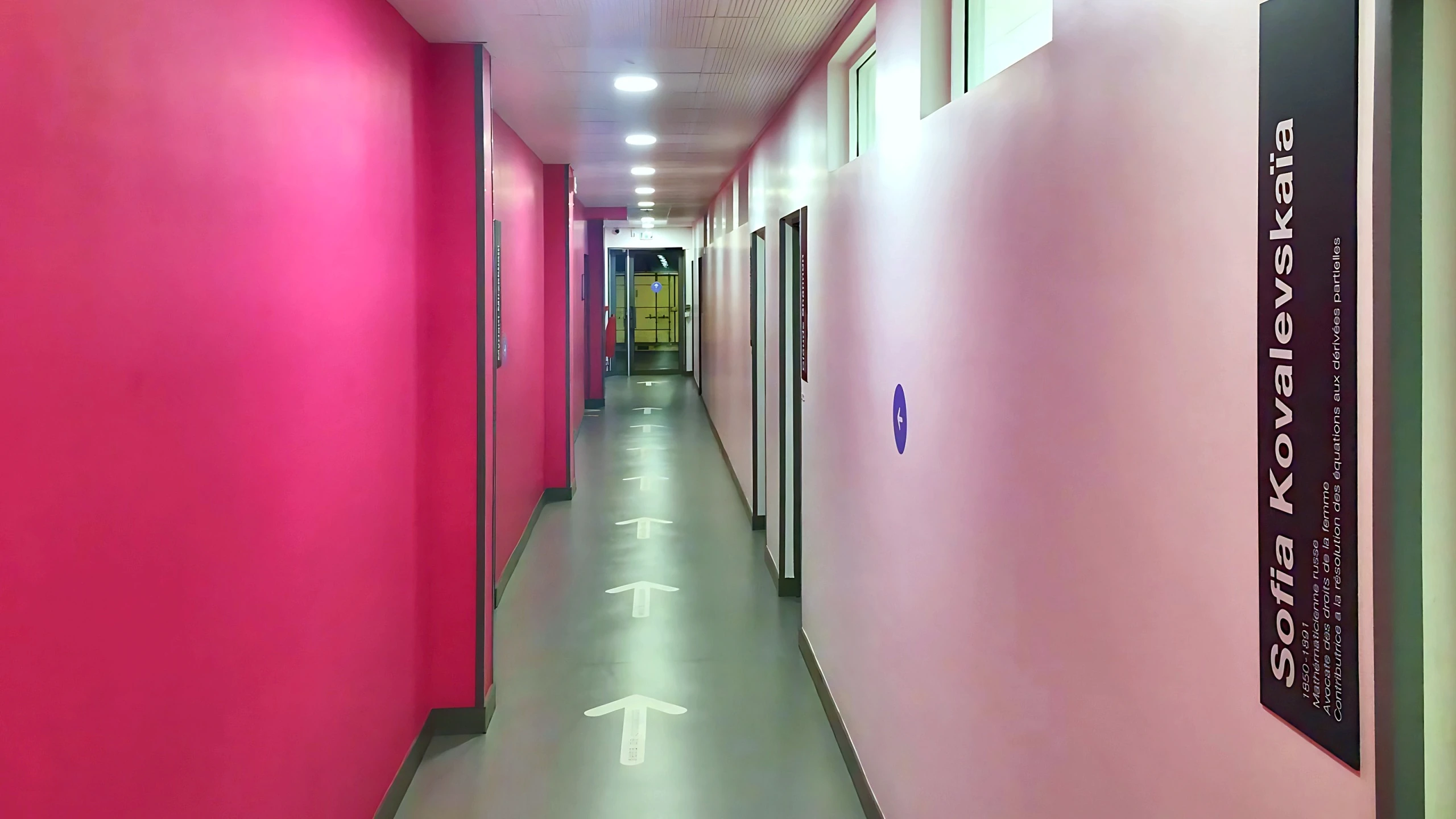
AI2, the Applied Institute of Artificial Intelligence, runs an MSc Applied AI & IoT taught 100% in English on the Hub Nikola Tesla campus in Écouen, 22 minutes from Paris Gare du Nord. It prepares the professional title described above, RNCP40554 “Architecte Internet des objets (IoT)”, certified by DATAKOO, AI2’s parent company, at level 7 (EQF 7), recognised by the French State. Graduates also receive the AI2 programme diploma. See also AI courses in Paris.
| MSc, 2 years | Direct entry, 18 months | |
|---|---|---|
| Who it is for | Holders of a relevant three-year bachelor’s in computing, electronics, networks or engineering | Holders of a related four- or five-year degree, after academic review |
| Structure | Year 1: shared applied-AI foundation (500 hours). Year 2: IoT specialisation (420 hours). Then a six-month internship | 12 months on campus in the IoT specialisation, then a six-month internship |
| Tuition | Year 1 €12,500, from €10,500 after a conditional AI2 scholarship; Year 2 €13,000 | €13,000, from €11,800 when a scholarship is awarded |
| Intakes | February, May and September 2027 | February, May and September 2027 |
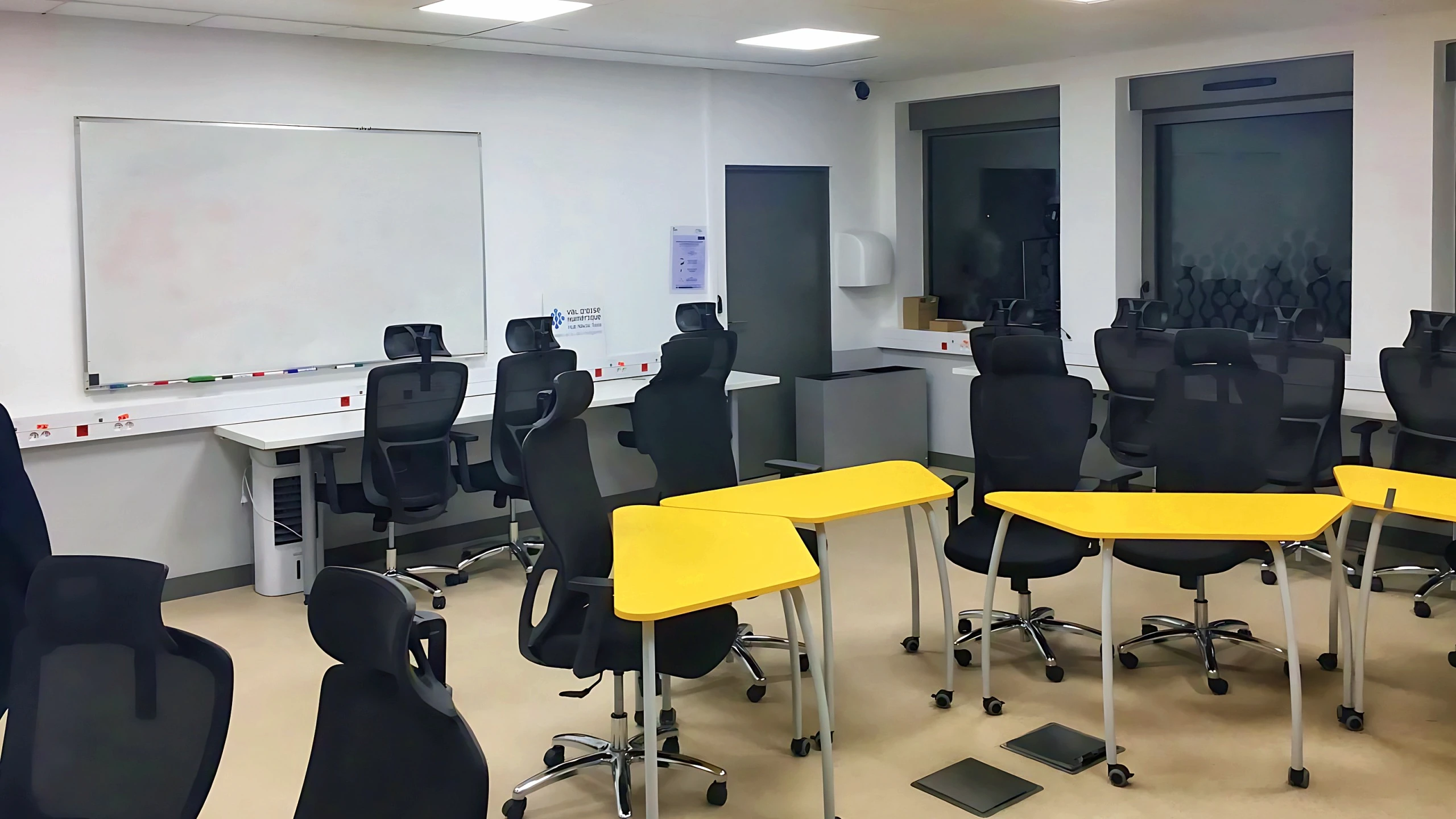
The IoT year follows the five competency blocks of RNCP40554, each closed by a jury defence: defining an IoT project, designing a multi-protocol ecosystem, building a secure platform on AWS IoT and Azure IoT, supervising the infrastructure with Prometheus, Grafana and the ELK stack, and governing IoT data with Airflow pipelines and edge models in TensorFlow Lite. Each student works with an ESP32, LoRa and Raspberry Pi lab kit, with PlatformIO, Mosquitto and Node-RED. The final professional project, an integrated IoT solution, is defended before the jury.
Admission is a file review and an online interview, with no GRE or GMAT. English at B2 is required (IELTS 6.0, TOEFL iBT 72 or equivalent) and French is not. From Year 2, the internship can be replaced by a salaried work-study contract once you sign with an employer. The career directions AI2 lists are IoT architect, IoT and edge-AI engineer, IoT project manager, digital-twin engineer and IoT security specialist. The priority deadline for February 2027 is 30 November 2026.
Full curriculum, fees and calendar: MSc Applied AI & IoT.
📘 Related guide: How to become an IoT engineer in France: roles, skills and tools.
📘 Related guide: Industrial IoT and Industry 4.0: the skills employers need.
📘 Related guide: Masters in IoT in France for Indian students: budget in rupees, visa and careers.
Frequently asked questions
Can I study a master’s in IoT in France in English?
Yes. English-taught options exist at public universities, engineering schools and private institutes, though the language varies by programme. AI2’s MSc Applied AI & IoT, for example, is taught 100% in English and requires no French.
What does an IoT engineer do?
An IoT engineer designs, builds and runs connected systems: choosing sensors and gateways, integrating wireless protocols, deploying a secure cloud or hybrid platform, monitoring it and turning device data into useful information with analytics and machine learning.
How much does an IoT master’s cost in France?
At public institutions under the higher education ministry, non-EU students pay €3,950 a year in 2026 to 2027. Private institutions generally charge about €6,000 to €18,000 or more a year, according to Campus France.
What are the entry requirements for an MSc in IoT in France?
Usually a bachelor’s in computer science, electronics, networks or engineering, programming basics and English at around B2 for an English-taught programme. Four- or five-year graduates can sometimes enter the second year directly.
Is IoT a good specialisation for jobs in France?
The official RNCP40554 record lists IoT roles across information technology, Industry 4.0 and smart cities, including architect, engineer, consultant, project manager and security expert. New EU rules such as the Cyber Resilience Act also make device security a legal requirement for manufacturers.
What is RNCP40554?
It is the French national register code of the professional title Architecte Internet des objets (IoT), a level 7 certification, the master’s level (EQF 7), certified by DATAKOO. AI2’s MSc Applied AI & IoT prepares this title.
Can I stay in France after an IoT master’s?
Yes. Graduates with a master’s or an equivalent diploma from France can request a one-year job-search permit. A job linked to your studies paying more than €2,800.53 gross a month needs no work authorisation.
Sources consulted on 27 October 2026: France Compétences: RNCP40554, Architecte Internet des objets (IoT) · European Commission: Cyber Resilience Act · Campus France: tuition fees · Campus France: LMD system · Campus France: registering to social security · Service-Public: student visa and resources (F2231) · Service-Public: job-search permit (F17319)
Apply to AI2’s MSc Applied AI & IoT: admissions reviews your file, holds an online interview and confirms your entry route, intake and tuition in writing.